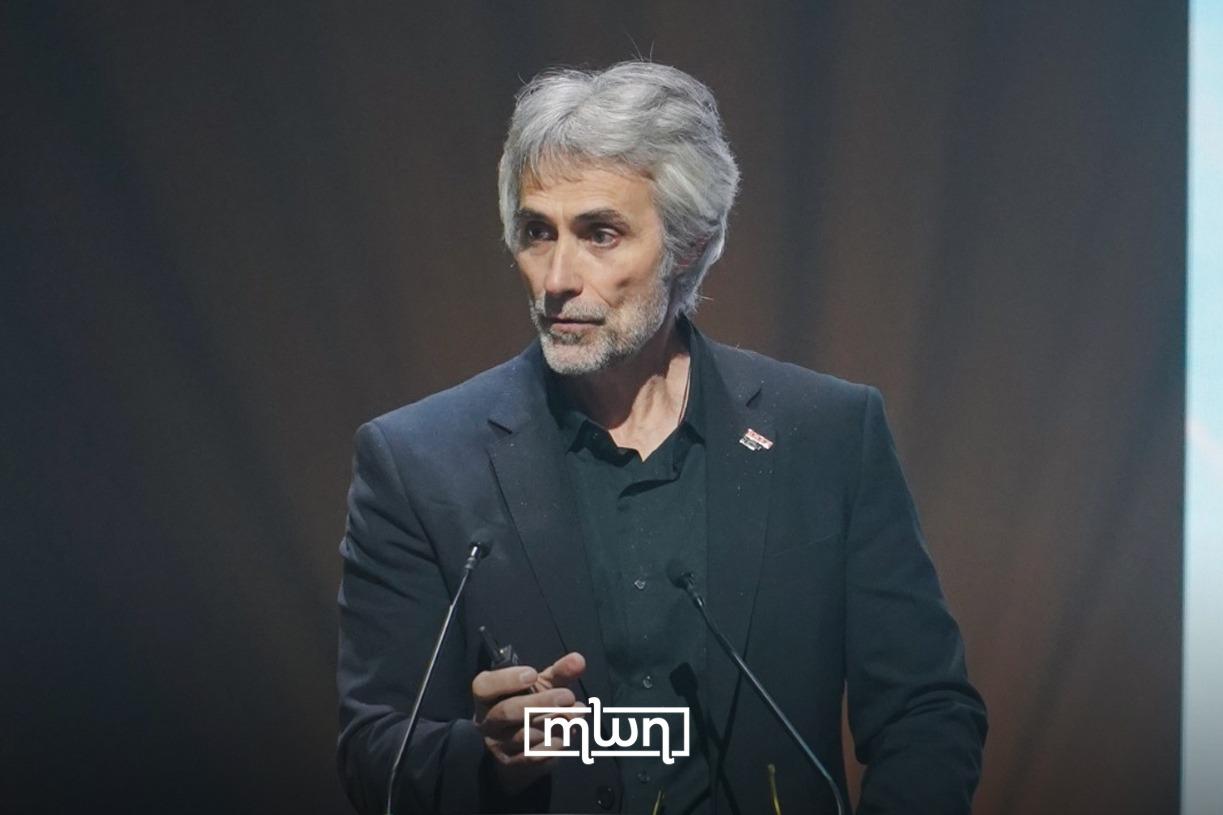
French Philosopher: Monarchy Protects Morocco from the Global Collapse of Meaning
المصدر: Morocco World News | Source: Morocco World NewsBenguerir – In a society where algorithms curate belief and success is measured in visibility, what keeps a nation from losing its soul? For French philosopher and sociologist Raphaël Liogier, the answer may lie in an unlikely place: Morocco’s monarchy.
Speaking to Morocco World News (MWN) on the sidelines of the 6th edition of UM6P’s Science Week in Benguerir, Liogier offered a sweeping critique of contemporary civilization – from the collapse of meaning in the digital age to the commodification of spirituality – while positioning Morocco as a rare case study in how tradition and modernity can coexist without devouring each other.
Liogier is a professor at Sciences Po Aix-en-Provence and the founder and holder of the Chair of Transitions at the Institute for Advanced Studies (IAS) at Mohammed VI Polytechnic University (UM6P). He previously directed the Observatoire du Religieux, the first European social sciences research center to study the rise of new Salafism among young Western Muslims, and has served as a visiting scholar at Columbia University.
His body of work spans more than sixteen books and over a hundred scientific articles, addressing questions of religious identity, globalization, secularism, and the mythologies that societies construct to give themselves meaning. He was the first expert the French Parliament consulted after the Charlie Hebdo attack in 2015.
His latest book, Success: L’Industrialisation du Mensonge (Success: The Industrialization of Lies), published in February by Les Liens qui Libèrent, has generated significant debate in France. Liogier has appeared multiple times on France Inter, France 2, and France Culture to discuss its central thesis, and is set to appear on La Grande Librairie.
He told MWN he plans to present the book in Marrakech at an upcoming conference organized by the Fédération Européenne de l’Éducation on April 23.
The weeklong Science Week event, running from March 30 through April 5 under the theme “Convergence(s),” has gathered more than 100 international scientists and experts at UM6P’s Benguerir campus. Sessions explore how scientific disciplines are increasingly merging at their boundaries, with intersections ranging from nanomaterials and medicine to artificial intelligence and education.
In a wide-ranging conversation that stretched from an initially allotted ten minutes to nearly forty, Liogier unpacked his concept of “hypermodernity,” diagnosed what he calls “mythical depression,” and reflected on what Morocco’s political and spiritual architecture offers the world at a moment of deepening global disorientation.
Hypermodernity: Freedom without the tools to be free
Liogier began by rejecting the widely used term “post-modernity,” arguing that societies have not yet fully arrived at modernity, let alone moved beyond it. “I don’t believe that we can reach post-modernity,” he told MWN. “We are not modern yet, totally modern yet.” What he sees instead is “hypermodernity” – a condition in which the multiplication of choices, identities, and modes of self-presentation has accelerated past the point where most individuals can meaningfully navigate it.
The Greek prefix “hyper,” he explained, means “more than” or “too much.” In a traditional world, there was the transmission of a single way of behaving. Modernity introduced multiple possibilities. Hypermodernity, by extension, floods individuals with an almost limitless array of ways to present themselves to the world – but without the inner resources to distinguish authentic expression from manipulation.
The question of whether this represents emancipation or a new form of control is, for Liogier, ultimately spiritual. Not in a religious-institutional sense, he clarified, but in the sense of whether individuals have cultivated the inner discipline to resist their own fantasies, emotions, and the anarchic pull of desire. Without that preparation, he warned, hypermodernity becomes worse than tradition, because in tradition, at least, “you are protected by this tradition because it gives you some kind of boundaries.”
Without spiritual grounding, he cautioned, individuals in a hypermodern world become “ten times a slave – a slave not only of ideology, but more and worse than ideology, because at least in ideology there is idea.” What replaces ideology, in his reading, is something far more insidious: global marketing. “They don’t even care about ideology, left, right,” he observed. “They can even use ideology to pretend that they have ideas and all that to manipulate you even more.”
Yet the opposite is equally true. If individuals are spiritually prepared, hypermodernity opens the door to a kind of freedom previously reserved for a narrow elite Liogier identifies as “the mystics” – those who maintained a direct, unmediated relationship with what he calls “the divine,” understood broadly as anything greater than the material self. “If we want to live hypermodernity in a positive way,” he proposed, “we need to have some kind of mystical training, which we don’t have nowadays.”
The lie nobody hides: Success as collective performance
This diagnosis feeds directly into the argument of Success, the book Liogier described as being about “the industrialization of lies.” The new form of deception he identifies is not the traditional lie that conceals something. It is a lie that conceals nothing – because, he contended, nobody believes in truth anymore.
“Everybody knows that everybody lies,” he told MWN. “The truth is the idea that there will be something that is more than the material world. But we don’t believe that.” In this framework, what contemporary societies protect is not truth but the lie itself. The person who is punished, Liogier suggested, is not the one who lies but the one who has not lied skillfully enough to maintain the collective performance.
He offered the example of an insurance salesman who feigns deep personal concern for his client’s family. Everyone involved understands the transaction is commercial. But in the absence of anything greater to hope for, the client accepts the performance. “A little tenderness, even with the insurance company guy, is fine,” Liogier remarked. It is what results from such routine enactments across advertising, social media, and public life that Liogier calls “the industrialization of lies.” The idea, to put it bluntly, is that our interactions have become a society-wide apparatus of performance that substitutes spectacle for substance.
Liogier acknowledged that even he is not exempt from the machinery he critiques. “I criticize the way success works, but still, I’ve done everything in my power to make my book successful,” he admitted. “Because I can’t escape that, even if I want to criticize it.”
The commodification extends to spirituality itself. Liogier noted that in Morocco, it has become fashionable among certain bourgeois circles to adopt Sufism, but practiced in the manner of yoga, stripped of its transformative rigor. People starving for meaning, he warned, become “manipulated by your desire not to be manipulated,” and traditions are repackaged as commercial products. “It’s strange, and it’s awful in a way,” he reflected, “because it starts from an authentic desire.”
When meaning dissolves: The risk of collective mental collapse
Asked whether algorithmic personalization and digital echo chambers have made shared meaning unsustainable, Liogier went further than the standard critique of fragmentation. The real danger, he argued, is not the multiplication of meanings but their dissolution.
Algorithms produce the illusion of multiple perspectives, he explained, but each user believes their feed represents the truth. Over time, the cumulative effect is not pluralism but nihilism – the creeping sense that nothing means anything at all. When that feeling takes hold, Liogier warned, we enter the realm of “mythical depression.”
For Liogier, human beings are “mythical animals.” They need narratives – individually and collectively – to construct a sense of destiny. He used the example of national identity: “Morocco does not exist,” he posited provocatively. “Like, we don’t exist as individuals. It’s just because we give ourselves a name.” A name becomes a narrative, and a narrative becomes meaning. But when that process breaks down – when names and stories feel empty – the result is a psychological free fall. “Depression is like being on a plane,” he illustrated. “When there is no air, you just crash.”
The ultimate risk, he cautioned, is “collective suicide, mentally collective suicide,” not in the literal sense, but as a civilizational state in which people can no longer believe in their own desires, their own names, or their collective futures.
Morocco’s monarchy: Tradition as a shield against manipulation
Turning to Morocco, Liogier described the kingdom’s balance between tradition and modernity as “impressive” and “really kind of an interesting model.” Unlike Britain, where citizens largely regard the monarchy with indifference, Moroccans – even the hyperconnected, globally aware younger generation – maintain an active attachment to the King and to tradition.
“Moroccans, they are modern,” he observed. “They are connected to the [contemporary] world. They are thinking about AI. And at the same time, they care about the King himself. They care about the tradition.” This dual orientation creates a protective equilibrium, Liogier argued. The strength of tradition prevents the total capture of Moroccan society by what he calls the “chaotic marketing manipulation” that characterizes ungoverned hypermodernity.
For the French philosopher, what makes Morocco’s model function is not merely the institutional architecture of monarchy. It is something rather deeper: trust. “If people trust the King, it’s because the King trusts God,” he told MWN. “But really, it’s not just something empty.” That trust in something transcendent – whatever one calls it – is what allows tradition to serve as a genuine shield rather than a hollow decoration.
At this point of the conversation, Liogier drew a sharp contrast with the French far right, which has long expressed admiration for Morocco’s monarchical stability while failing to understand what sustains it. Figures like Marine Le Pen, he noted, see in Morocco what France lost after the Revolution – order, hierarchy, continuity. But the French extreme right wants tradition without trust, Christianity without genuine belief in the existence of God or the reality of Jesus. “The tradition will be like, we want to be Christian, but we don’t care about the reality of the existence of Jesus or God,” he noted. “No, that doesn’t work this way.”
Empty tradition, divorced from authentic conviction, is simply the final stage of marketing. “An extreme right is part of the marketing now,” Liogier asserted. Morocco, he suggested, has so far avoided this trap precisely because its tradition remains rooted in something its people genuinely believe in.
Symbolic crisis and the politics of lost recognition
Liogier situated the rise of European populism within what he calls a “symbolic crisis” – not an abstract concept, he insisted, but the lived experience of feeling unrecognized and humiliated. France, which for centuries occupied the symbolic center of global civilization – setting the standards of dress, language, culture, and self-presentation – now watches that centrality erode.
He traced the depth of that historical position with striking examples. Russian elites spoke French. English kings spoke French. Leibniz wrote in French rather than German, which was considered a “barbarian language.” Even today, he pointed out, a nationalistic Chinese official pushing his child to study music will steer him toward European music – a residual gravitational pull that persists beneath ideological surfaces.
“Imagine this country, France, that has actually lost this symbolic recognition on the scale,” Liogier reflected. “Imagine the complex, the feeling that is just feeling humiliated for all this past that just vanished.” Extreme-right movements, he argued, build their political base on precisely this symbolic frustration – a dynamic now spreading from France to America, encapsulated in slogans like “Make America Great Again.” For him, “That means it’s not great anymore.”
A Machiavellian case for principled governance
Faced with the question of whether Morocco’s religious authority represents genuine conviction or strategic instrumentalization, Liogier refused to succumb to traditional binary thinking. He instead rehabilitated Machiavelli, arguing that a careful reading of The Prince reveals a thinker concerned with maintaining stability in chaotic, violent times – not a cynical manipulator.
He invoked the story of Oskar Schindler, the German businessman who compiled a list of Jewish workers destined for Nazi camps – an apparently monstrous act that, by earning the regime’s trust, ultimately allowed him to save far more lives. “That’s the Machiavellian way,” Liogier explained. “But because he has principles.”
Applied to Morocco, Liogier suggested there is no contradiction in a leader operating with strategic sophistication while maintaining authentic trust. “He needs to cheat the system by doing things that look like they go to the system, but escape the manipulation of the system,” he proposed. The key distinction is whether principle – genuine conviction in something greater – underlies the strategy.
Gen Z and the schizophrenia of dual belonging
On the question of Morocco’s younger generation, Liogier offered a diagnosis that was both sympathetic and candid. Young Moroccans, connected to the global world through their smartphones, carry “one foot in tradition and one foot in the global world.” This dual position generates new aspirations – some of which can be fulfilled within Morocco’s social framework, and some of which cannot.
He acknowledged the frustration that arises from encountering limits on expression that would not exist in other monarchies. “In Britain, you can spit on the portrait of the king; nobody cares,” he noted. “Here, don’t try to do that.” These boundaries, he suggested, are simultaneously protective and constraining – a source of both stability and a certain “schizophrenia” that Moroccan thinker Abdallah Laroui has also identified.
Morocco’s identity crisis, Liogier concluded, is better managed than Algeria’s, precisely because the strength of tradition provides a framework. But the deeper tension – between a traditional society that remains vital and a modernity that no one can disconnect from – persists as the central challenge of Moroccan hypermodernity.
“It’s better administered, this modernity, hypermodernity,” Liogier conceded, “but in another way, it’s more schizophrenic.”
The post French Philosopher: Monarchy Protects Morocco from the Global Collapse of Meaning appeared first on Morocco World News.
ملاحظة تحريرية | Editorial Note: نُشر هذا المقال في الأصل بواسطة Morocco World News. خبر (Khabr) هي منصة إعلامية أردنية مرخّصة تعمل بالذكاء الاصطناعي. نضيف قيمة تحريرية من خلال: تحليل ذكي للأخبار، ملخصات تلقائية، رواية صوتية بالذكاء الاصطناعي، ترجمة متعددة اللغات، وتدقيق الحقائق. هدفنا جعل الأخبار أكثر وضوحاً وسهولةً للقارئ العربي.
This article was originally published by Morocco World News. Khabr is a licensed Jordanian AI-powered news platform (Registration #82086). We add editorial value through: AI-powered news analysis, automated summaries, AI audio narration, multi-language translation (Arabic, English, French, Turkish), and AI fact-checking. Our mission is to make news more accessible and understandable for Arabic-speaking audiences worldwide.