Explained: How government’s delimitation push will reshape states’ representation in Lok Sabha
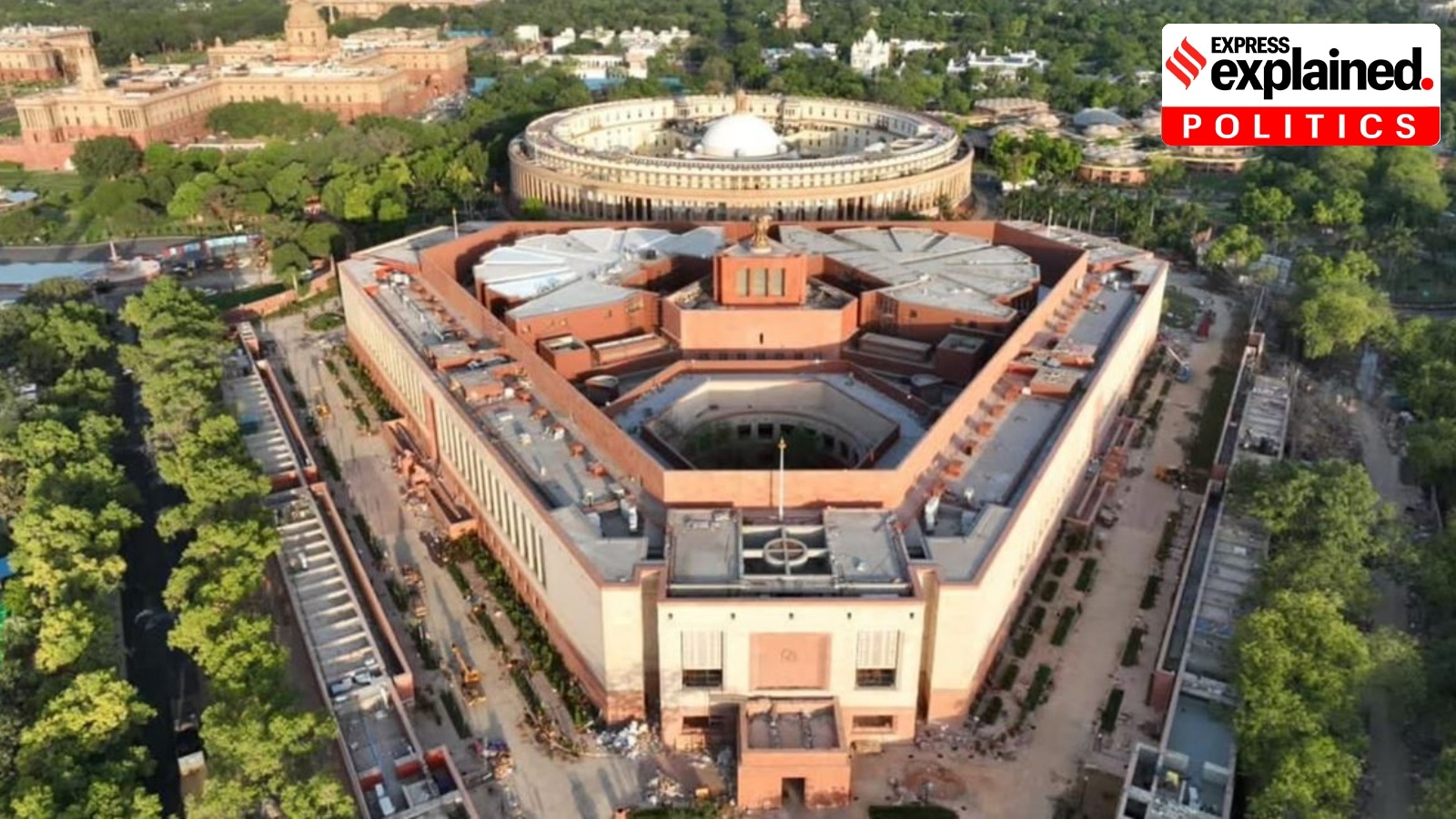
Weather ePaper Today’s Paper Journalism of Courage Home ePaper Politics Explained Opinion India Business Premium Cities UPSC Entertainment Sports World Lifestyle Tech Subscribe Sign In TrendingUPSC OfferIPL 2026US NewsPuzzles & GamesLegal NewsFresh TakeHealthResearch🎙️ Podcast Advertisement function checkAndLoadWindowSizeScript() { if (window.jQuery) { // jQuery is loaded, include your script jQuery(document).ready(function($) { // Your existing script for checking window width if (window.innerWidth) var page_w = window.innerWidth; else if (document.all) var page_w = document.body.clientWidth; if (page_w > 1024) { $(".add-left, .add-right").show(); } else { $(".add-left, .add-right").hide(); } }); } else { // jQuery is not loaded, check again after 0.2 seconds setTimeout(checkAndLoadWindowSizeScript, 200); } } // Initial call to the function checkAndLoadWindowSizeScript(); NewsExplainedExplained PoliticsExplained: How government's delimitation push will reshape states' representation in Lok Sabha Explained: How government’s delimitation push will reshape states’ representation in Lok Sabha MPs are gathering today to decide on Bills pertaining to delimitation. Their passage will pave the way for implementing women’s reservation. Written by: Amitabh Sinha, Vikas Pathak8 min readNew DelhiApr 16, 2026 07:00 AM IST The Women’s Reservation Act was passed through another Constitutional amendment in 2023 but had been kept in abeyance till the seats in Lok Sabha and state Assemblies were increased through the long-pending delimitation exercise. Make us preferred source on Google Whatsapp twitter Facebook Reddit PRINT Parliament’s Budget Session is reconvening today for three days to decide on giving effect to two landmark Constitutional changes that will reshape Indian democracy. The first is a Constitutional amendment to increase the number of seats in Lok Sabha to up to 850 from the present 543. Accompanying it will be a Bill to constitute a Delimitation Commission to carve out the new Parliamentary constituencies. The government has tethered the delimitation exercise to the second landmark change — the implementation of the Women’s Reservation Act, which seeks to reserve one-third of seats in Lok Sabha and the state Assemblies for women. The Women’s Reservation Act was passed through another Constitutional amendment in 2023 but had been kept in abeyance till the seats in Lok Sabha and state Assemblies were increased through the long-pending delimitation exercise. This dual move — the increase in seats in Lok Sabha and state Assemblies, and 33% reservation for women in these legislatures — represents one of the most fundamental changes in Indian democracy since Independence. These changes seek to make the Indian democratic system more representative, inclusive and equitable. Women’s reservation had already become a part of the Constitution in 2023. All that was left was its actual implementation in the elections. This implementation had been linked to the delimitation exercise, which seemed feasible only after 2027 after the publication of the results of the Census that had been set in motion earlier this year. But the government has decided to expedite the delimitation exercise by making amendments in the provision of the Constitution that had put a freeze on this till the publication of first Census results after 2026. Facilitating the Constitutional amendment on delimitation is, therefore, the reason the three-day Parliamentary session has been convened. Article 82 of the Constitution provides for ‘readjustment’ of constituencies of Lok Sabha and the state Assemblies after every Census. The readjustment can lead to a change in the number of seats or a change in boundaries of constituencies. This is done to account for the changes in population over time, the main idea being that the value of the vote cast by every voter across the country has a similar value or weight. A Lok Sabha MP, for example, should, broadly speaking, represent a similar number of people, irrespective of whether he or she is elected from Bihar or Tamil Nadu. That means that the population of every constituency should, as far as possible, be similar. For this reason, Article 81 says the number of Lok Sabha seats allocated to every state should be such that “the ratio between that number and the population of the state is, so far as practicable, the same for all states”. This principle applies in the case of state Assemblies as well. The delimitation exercise, therefore, is meant to preserve the principle of ‘one vote, one value’. The delimitation exercise has not been held since 1976, mainly owing to objections by some states that this tended to put them at a disadvantage. States whose populations have grown at a slower rate feared that their allocation in the Lok Sabha, proportionately speaking, would come down compared to states whose populations grew at a faster rate. As a result of these objections, the delimitation exercise was frozen for 25 years through a Constitutional amendment in 1976. In the year 2001, when this period ended, the freeze was extended for another 25 years, till 2026, through another Constitutional amendment. This government had made its intention clear about not extending the freeze any further, even though the states with slow-growing populations have expressed concerns about the population differential becoming more acute in the intervening years. The government sought to break the political stalemate by offering to maintain the existing proportion in the allocation of seats to different states, while increasing the total number of seats to accommodate for the growth of population in the last 50 years. In repeated public statements, the government said it would increase the existing allocations by a fixed percentage — 50% — so that the overall proportion between the states is unchanged. This sought to address the main objection of the states which feared that, compared to some others, their seats, and thus representation in Lok Sabha, would come down. The Constitutional amendment Bill, made public on Tuesday, however, does not make a mention of the 50% across-the-board increase. All it does is propose to increase the total number of seats in Lok Sabha to up to 850 (815 from the states, 35 from the Union Territories) from the existing 543. It seeks to do some other important things as well. It proposes to delink the delimitation exercise from the Census, and does away with the Constitutional necessity of carrying out a delimitation after every Census. Henceforth, a delimitation can be carried out whenever Parliament approves such an exercise. It would be based not on the results of the last published Census report, but on the Census report decided by Parliament. The amendment proposes changing the definition of population from the “last preceding census” to “population as ascertained at such census, as Parliament may by law determine”. This will enable the current government to carry out a delimitation exercise on the 2011 Census report, without having to wait for the results of the 2027 Census. This also gives Parliament a wider option when it comes to allotment of seats. The fact that the Constitution amendment Bill on delimitation does not mention a flat 50% increase in seats across all states reintroduces uncertainty in the process to be adopted for increase in seats. It is likely to result in another political slugfest. On the other hand, if the government indeed proceeds with a 50% increase in Lok Sabha seats in all states, the ‘one vote, one value’ principle would be compromised. For example, as of now, a Lok Sabha MP in Himachal Pradesh represents about 17.16 lakh people, on an average. Meanwhile an MP in neighbouring Haryana represents an average of 25.35 lakh people. The vote of an average person in Haryana, therefore, has a lower value than that in Himachal Pradesh. The value of the vote cannot be entirely equal, but the idea of delimitation is to contain it in as tight a bracket as possible. This is possible only if the seats are adjusted solely on the basis of population. But that can lead to big changes in the existing proportion of seats among the states. For example, according to one scenario, Lok Sabha seats in Uttar Pradesh can increase from 80 to 140, but that in Tamil Nadu would rise only to 51 from the present 39. The Opposition parties say that the Bills are riddled with contradictions and make no mention of the proportion of seats allocated to all states remaining unchanged, unlike what sources in the government had been saying. So, they argue that this would lead to states that did not implement family planning being “rewarded” with a higher share of seats. They have also opposed the idea of a 50% increase in the Lok Sabha seats of all states, saying that the gap between states whose population has stabilised and the ones whose population hasn’t will increase in absolute numbers. Telangana Chief Minister Revanth Reddy has suggested a hybrid model for seat allocation that takes into account not just population but also the gross state domestic product. The Opposition has accused the government of not calling an all-party meeting despite their demanding it. Sources in the government say it will attach a schedule mentioning proportionate increase in the number of Lok Sabha seats for every state with its Bills to allay the fears of southern states that the proportion of their seats in the Lower House would fall. A Schedule is an additional section to a Bill that provides detailed information supporting the text of the Bill. The Schedule is expected to include the precise number of seats that will be allocated to each state. Vikas Pathak is deputy associate editor with The Indian Express and writes on national politics. He has over 17 years of experience, and has worked earlier with The Hindustan Times and The Hindu, among other publications. He has covered the national BJP, some key central ministries and Parliament for years, and has covered the 2009 and 2019 Lok Sabha polls and many state assembly polls. He has interviewed many Union ministers and Chief Ministers. Vikas has taught as a full-time faculty member at Asian College of Journalism, Chennai; Symbiosis International University, Pune; Jio Institute, Navi Mumbai; and as a guest professor at Indian Institute of Mass Communication, New Delhi. Vikas has authored a book, Contesting Nationalisms: Hinduism, Secularism and Untouchability in Colonial Punjab (Primus, 2018), which has been widely reviewed by top academic journals and leading newspapers. He did his PhD, M Phil and MA from JNU, New Delhi, was Student of the Year (2005-06) at ACJ and gold medalist from University Rajasthan College in Jaipur in graduation. He has been invited to top academic institutions like JNU, St Stephen’s College, Delhi, and IIT Delhi as a guest speaker/panellist. ... Read Moreالمصدر: Indian Express | Source: Indian Express
ملاحظة تحريرية | Editorial Note: نُشر هذا المقال في الأصل بواسطة Indian Express. خبر (Khabr) هي منصة إعلامية أردنية مرخّصة تعمل بالذكاء الاصطناعي. نضيف قيمة تحريرية من خلال: تحليل ذكي للأخبار، ملخصات تلقائية، رواية صوتية بالذكاء الاصطناعي، ترجمة متعددة اللغات، وتدقيق الحقائق. هدفنا جعل الأخبار أكثر وضوحاً وسهولةً للقارئ العربي.
This article was originally published by Indian Express. Khabr is a licensed Jordanian AI-powered news platform (Registration #82086). We add editorial value through: AI-powered news analysis, automated summaries, AI audio narration, multi-language translation (Arabic, English, French, Turkish), and AI fact-checking. Our mission is to make news more accessible and understandable for Arabic-speaking audiences worldwide.