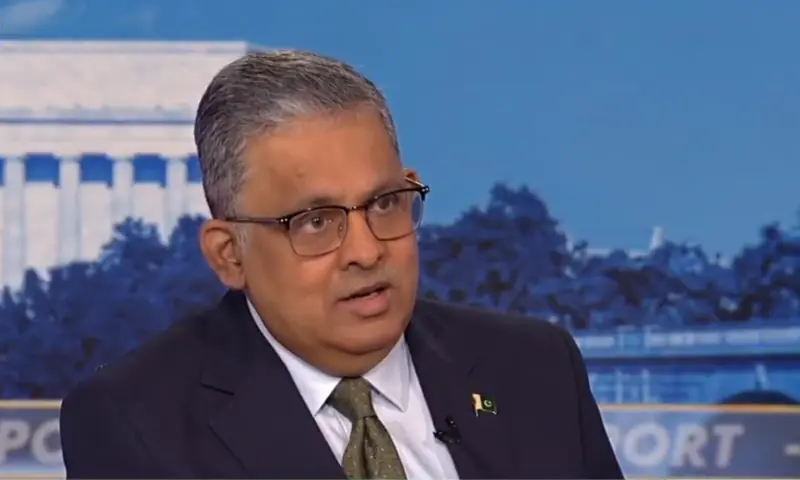
Pakistan’s Ambassador to the US Rizwan Saeed Sheikh has reaffirmed Islamabad’s commitment to facilitating dialogue between the United States and Iran, even as regional tensions intensify.
In an interview broadcast on Tuesday, Ambassador Sheikh told Fox News that Pakistan is “committed to providing every possible facilitation for fruitful dialogue”, while stressing that ultimate decisions rest with the conflicting parties.
“While Pakistan continues to be the facilitator, it is actually upon the conflicting parties themselves to not only create the prerequisites for negotiations and to be able to conduct them in all earnest, but they will have to take the decisions which make it successful,” Ambassador Sheikh said.
He described the situation as “a highly complex issue involving political, economic, and regional factors” and expressed gratitude that both sides have shown confidence in Pakistan’s ability to help mediate.
“We are also mindful of the fact that it is not an easy process. It’s a very complicated matter with too many moving pieces, economic, political,” he said.
The ambassador highlighted Pakistan’s long-standing tradition of peace-based diplomacy, seemingly alluding to its historical role in bridging divides between major powers, including China and the United States during the Cold War.
Deputy Prime Minister and Foreign Minister Ishaq Dar is also visiting China on a one-day visit on Tuesday to enhance the peace process.
“Pakistan’s offer to play a mediating role in the recent dispute between the United States and Iran is in the wider regional interest,” Ambassador Sheikh said.
“Our recent offer is made in good faith and includes other regional partners. We are hopeful and willing to move matters forward in the region’s broader interest.”
The envoy added, “We are trying to create the conducive setting for this dialogue to take place.”
However, he stressed, “Diplomacy is a gradual process that requires time. Pakistan believes in negotiation and diplomacy as the foundation for sustainable peace.”
Yet, the diplomatic path faces immediate challenges as US President Donald Trump continues to issue forceful warnings, including an apparently aggressive social media post about targeting Iran’s economic infrastructure.
Analysts point out, however, that even in that post, he emphasised “serious discussions” with Iranian officials “to end” US military operations in Iran and claimed that “great progress has been made” in those talks.
At the same time, Trump reiterated his demand for Iran to reopen the Strait of Hormuz immediately or face dire consequences.
Hours later, White House Press Secretary Karoline Leavitt clarified at a briefing that reopening the Strait is something “the Administration is working towards”, but it is not one of the core objectives of the operation.
She defined the core objectives as destroying Iran’s navy, dismantling its missile and drone infrastructure, weakening its regional proxies, and preventing Iran from obtaining a nuclear weapon — something that Tehran denies being its objective.
Analysts say this provides the Trump administration enough flexibility to declare at any stage that its objectives have been achieved and end the conflict, highlighting the unpredictable nature of the situation.
Islamabad praised from within US
Pakistan’s initiative has also drawn support from US lawmakers.
Rep. Ryan Zinke, a Republican from Montana, praised Pakistan’s leadership in hosting peace talks and delivering “President Trump’s 15-point plan for peace in the Middle East. Bravo Zulu.”
Rep. Jack Bergman, the Republican co-chair of the Congressional Pakistan Caucus, called Pakistan’s role “key to lasting stability” and emphasised that “strong partnerships and decisive action” are essential.
Bergman also reshared a Financial Times report highlighting Pakistan’s central positioning in the Iran-US peace process.
Analysts note that Pakistan’s efforts as a neutral facilitator could enhance its diplomatic standing in both Washington and Tehran, offering a platform for dialogue even as the drumbeats of war grow louder.
Ambassador Sheikh’s full statement underscores Islamabad’s commitment to constructive engagement and its belief that sustained negotiation, rather than confrontation, remains the only path to lasting stability in a region fraught with uncertainty.
Islamabad hosted a four-country meeting over the weekend involving Saudi Arabia, Türkiye and Egypt, where foreign ministers met for about 100 minutes and emphasised the need for de-escalation and dialogue.
Providing details of that meeting, Dar had hinted that Pakistan could host direct talks between Iran and the US in the coming days “for a comprehensive and lasting settlement of the ongoing conflict”.
Pakistan has taken centre-stage in a process to mediate between the US and Iran, being carried out in collaboration with Riyadh, Ankara and Cairo, with Dar confirming last week that “indirect talks” were taking place between Washington and Tehran through messages being relayed by Pakistan.