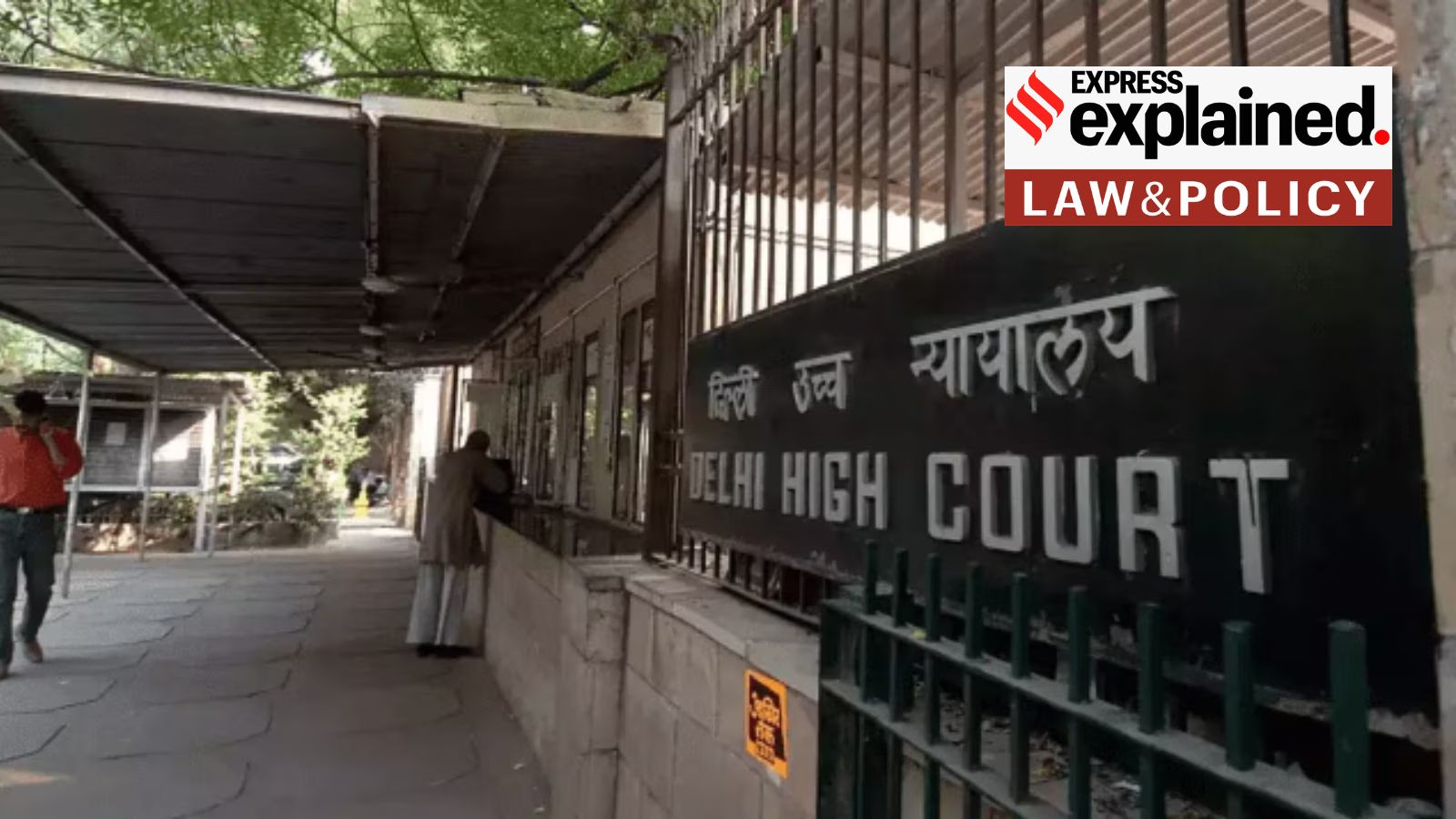
Weather ePaper Today’s Paper Journalism of Courage Home ePaper Politics Explained Opinion India Business Premium Cities UPSC Entertainment Sports World Lifestyle Tech Subscribe Sign In TrendingUPSC OfferIPL 2026US NewsPuzzles & GamesLegal NewsFresh TakeHealthResearch🎙️ Podcast Advertisement function checkAndLoadWindowSizeScript() { if (window.jQuery) { // jQuery is loaded, include your script jQuery(document).ready(function($) { // Your existing script for checking window width if (window.innerWidth) var page_w = window.innerWidth; else if (document.all) var page_w = document.body.clientWidth; if (page_w > 1024) { $(".add-left, .add-right").show(); } else { $(".add-left, .add-right").hide(); } }); } else { // jQuery is not loaded, check again after 0.2 seconds setTimeout(checkAndLoadWindowSizeScript, 200); } } // Initial call to the function checkAndLoadWindowSizeScript(); NewsExplainedExplained LawDelhi HC pulls up Sentencing Review Board in Mattoo case: What is premature release? Delhi HC pulls up Sentencing Review Board in Mattoo case: What is premature release? The board’s order dated November 2025 stated that a police report submitted to it described Singh’s crime as heinous and that his presence in the area, if released, “will affect public peace and tranquility.” This reasoning did not pass muster with the court Written by: Amaal Sheikh7 min readNew DelhiApr 20, 2026 10:00 AM IST The court, which had set aside the first rejection in July 2025 and sent the matter back for fresh consideration, is now seized of the second one. Make us preferred source on Google Whatsapp twitter Facebook Reddit PRINT The Delhi High Court last week (April 16) criticised the Sentencing Review Board’s (SRB) latest rejection of Santosh Kumar Singh’s plea for premature release. Justice Anup J Bhambhani said the board appeared to be deciding cases like the blindfolded Lady Justice, but not as the metaphor was intended. “SRB seems to be proceeding on public perception. You are a hugely unpopular person… SRB is looking at things like Lady Justice as she originally was, with a blindfold. Your name doesn’t sound good, so I am rejecting it,” the judge remarked orally. Mattoo, a Delhi University law student, was raped and killed by Santosh, her senior, in 1996. Even as a lower court had acquitted him in 1999 for lack of evidence, despite the judge saying that he was guilty, the Delhi High court awarded him the death penalty in 2006. The Supreme Court in 2010, however, had commuted the death sentence to life imprisonment. Singh has spent nearly three decades in custody. The board rejected his premature release plea for the second time. The court, which had set aside the first rejection in July 2025 and sent the matter back for fresh consideration, is now seized of the second one and has listed it for hearing on April 20, clubbing it with several other cases where the SRB has similarly shut the door. Premature release allows life convicts to be released early if they are deemed to be reformed, rehabilitated and no longer a threat to society. The powers of clemency are derived from both constitutional and statutory frameworks. Articles 72 and 161 of the Indian Constitution empower the President and the Governor of the state to grant remission in appropriate cases. Such powers are also infused in state governments, as laid down in the Bharatiya Nagarik Suraksha Sanhita (BNSS), Sections 473 and 474. The statutory floor for consideration is 14 years of actual imprisonment. For offences where death was a sentencing option, as in Singh’s case, Section 475 of the BNSS makes that threshold mandatory. Eligibility, however, does not guarantee consideration. The SRB, comprising senior state officials, including the DG of Prisons, the Police Commissions, and the Chief Secretary, is the body that must first examine each case and pass its recommendation to the government. Advocate-on-Record RHA Sikander says that “general factors are good conduct, behaviour in jail, and no other involvement. Whether you had parole or interim bail, you complied with the conditions and did not jump it.” The nature of the offence matters, but it cannot be the only consideration. “After some point of time, you will have to release the person. How long are you going to keep the person, especially when the behaviour is good?” The legal framework for remission was carved out by the SC in its 2015 judgement in the UOI vs V Sriharan, arising from the Rajiv Gandhi assassination case. The court held that remission is not an unchecked executive power. It requires mandatory judicial consultation and reasoned orders and must be guided by a range of factors, the convict’s conduct, age at the time of the offence, psychological profile, and prospects of rehabilitation. The heinousness of the offence, by itself, does not clear the bar for denial. The board’s order dated November 2025 stated that a police report submitted to it described Singh’s crime as heinous and that his presence in the area, if released, “will affect public peace and tranquility.” The board noted that Mattoo’s brother and five others had opposed the release in writing, as had the president of the All India Kashmiri Samaj and a BJP spokesperson and former Delhi MLA. It said that since the offence was premeditated, it thus rejects the release of the convict. The reasoning did not pass muster with the court. The observation about public peace, Advocate RHA Sikander noted, “is a conjecture. How will it affect? You can impose conditions instead.” Justice Bhambhani made a similar point during the Thursday hearing. He said that he was dealing with “worse cases”, including a convict who had spent 41 years inside, where the SRB was rejecting pleas on grounds of heinousness alone, even when jail authorities had recommended otherwise. “There is something called reformation. There is something called 30 years in custody. There is something called transfer to open jail,” the court said. The court also acknowledged Mattoo’s family’s position directly. “I understand your sentiments. What he did was unacceptable, and the system punished him. He got life [imprisonment]. The offence was heinous. What do we do? We confine a man like this?” he said. The courts have cleared the way for release in cases that drew comparable public attention. Manu Sharma (also known as Siddharth Vashisht), convicted of the 1999 shooting of Jessica Lall at a Delhi party, walked out in 2020 after the LG approved his premature release on the SRB’s recommendation after more than two decades in prison. The SRB report, sent to the LG, noted that the board “unanimously recommends premature release” on account of his conduct in jail. Sushil Sharma, convicted in the 1995 Tandoor murder case for killing his wife and attempting to dispose of her body, was released in 2018 after 23 years. The High Court had stepped in after the SRB rejected his plea. The SC turned away the Delhi government’s challenge to that release in 2023. In the Nitish Katara murder case, co-convict Sukhdev Yadav, who was sentenced to 20 years without remission, was released by the SC in July 2025 after his term elapsed, the court holding that no further SRB clearance was needed once a fixed sentence period had run its course. A bench of Justice Nagarathna and KV Vishwanathan had noted, “how can the SRB sit over an order of the judicial authority? If this is the approach, then every convict will die in jail. Is this the conduct of an executive?” The pattern the court is responding to What the Mattoo case surfaces is a pattern in remission matters. SRB tends to be cautious in cases that draw sustained public attention, and recommendations for release are relatively rare. Advocate Sikander says the reasons are often as much institutional as legal. “There is always a concern about how such decisions will be viewed,” he said, adding that in many cases the final call eventually emerges through the courts. The result is a familiar cycle, with SRB rejecting the request, the convict moves a writ petition and the court either asks for reconsideration or examines the decision itself.
المصدر: Indian Express
| Source: Indian Express