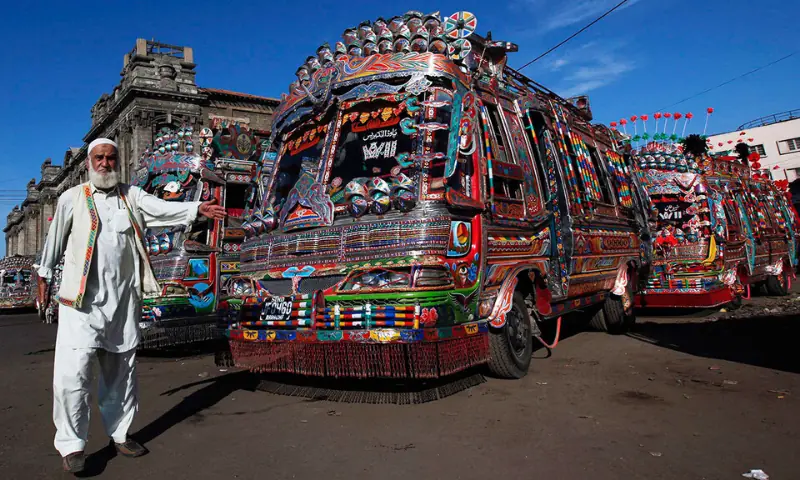
KARACHI: Although a ceasefire between the US and Iran is in place and there is optimism about a significant reduction in fuel prices, citizens using public transport across the city continue to pay inflated fares as bus owners widely ignored a Sindh government directive to freeze fares in return for a fuel subsidy, it has emerged.
The practice of overcharging appears to have become rampant, as transporters — including operators of buses, minibuses, Qingqi rickshaws, school vans and goods carriers — continue to demand higher fares.
Following the government’s subsidy announcement, many citizens were expecting transport fares to revert to pre-war levels, particularly after transport bodies reportedly agreed to roll back rates.
However, the government’s “comprehensive” strategy to shield low-income commuters from rising transportation costs triggered by global fuel price fluctuations has yet to provide tangible relief.
Passengers, parents and businesses say heavy fares unbearable; commuters paying nearly ‘double’ the amount despite govt’s directive to charge pre-war fares
Speaking to Dawn, a passenger, who chose not to board a bus after being told the minimum fare was Rs50, said such experiences had become routine since petroleum prices surged.
“I used to pay Rs20, sometimes Rs30, for a short distance. Now they are demanding double. Is this justified? Have fuel prices doubled? Absolutely not. Then why are fares being doubled?” he asked.
A visit to M.A. Jinnah Road near the gutted Gul Plaza building revealed a similar situation, with bus conductors informing passengers beforehand that the minimum fare, up to next stop, was Rs40 to Rs50.
Another passenger said that when he reminded a conductor of the government’s directive against fare hikes, he was told to either pay the increased fare or get off the vehicle.
He questioned when the authorities would ensure enforcement of the fare freeze “in its true spirit” and what action would be taken against transporters openly violating official directives.
Shahbaz, a college student waiting for a Qingqi rickshaw to reach his coaching centre, said the increase in fares had significantly strained his finances.
“I work part-time to support my education, but the additional Rs60 in daily commuting costs has become a burden,” he said, adding that he now walks at least two kilometres each way to manage expenses.
“Earlier, Qingqi drivers sometimes offered concessions to students and the elderly, but that sense of accommodation seems to be fading,” he added.
Tauheed, a motorcycle user, questioned the effectiveness of the government’s cash subsidy for bike users.
“Before the fuel price hike, I could go from Gulistan-i-Jauhar to City Courts and back with Rs300 worth of petrol. Now it costs around Rs450. The subsidy will only cover the additional expense for 10 to 12 days; the rest I have to bear myself,” he said.
Parents of schoolchildren have also complained about a sharp increase in van fees, with some reporting a rise from Rs1,000 to Rs2,000 per month, which drivers attribute to higher fuel costs.
“For families with two or three school-going children, this increase is not manageable. Transport alone is now taking up a significant portion of our monthly budget,” said a parent.
A working couple said, “Both of us are working, and we rely on van services. We cannot drop and pick our children ourselves, so we are forced to accept whatever fare is being demanded.”
Transport cost across sectors
The situation is no different for users and operators of ride-hailing services, where fares have already increased in response to recent fuel price adjustments.
An elderly bike rider working with a ride-hailing service, seen walking alongside his motorcycle, said rising fuel costs had forced him to adopt “unconventional” measures.
“I am diabetic and need to walk regularly. Now I walk with my bike — it helps my health and saves fuel as well,” he remarked.
The impact is also being felt in the business sector.
Zaki, a representative of a private textile firm, told Dawn that goods transporters were reluctant to accept bookings unless significantly higher charges were paid.
“An inter-city shipment that previously cost Rs125,000 is now being quoted at Rs250,000,” he said.
He added that transporters were justifying the increase by pointing out that their vehicles run on diesel, which remains expensive at Rs520 per litre. Although a subsidy has been announced, it has yet to be implemented.
Similarly, a wholesale dealer of daily commodities said in-city transportation costs had also risen sharply.
“A delivery charge that previously stood at Rs5,000 now ranges between Rs8,000 and Rs9,000. We are forced to absorb the additional burden, as we cannot arbitrarily increase the prices of essential goods,” he said.
Dawn tried to reach transport authorities and the transport minister’s spokesperson for their version, but they did not respond.
Published in Dawn, April 9th, 2026