Climate scientists have dropped their most apocalyptic forecasts on global warming after finding they were “implausible”.
Scientists and the media have long quoted from the IPCC’s worst-case scenarios, which foresaw temperatures soaring by up to 5C, massive sea level rises and global crop failures.
Some even predicted it could ultimately bring about extinction events on the scale of the dinosaurs.
But now modellers working for the UN-backed IPCC, which provides climate change information to governments, say the chances of this worst-case scenario actually happening are “negligible”.
The scenario was known as RCP 8.5 and, later, SSP5 8.5.
Researchers say it was intended “to explore an unlikely high-risk future” but it was “widely used by some experts, policymakers and the media as something else entirely: as a likely ‘business as usual’ outcome”.
It has been cited more than 45,000 times in academic papers and fed through to informing policy.
The World Economic Forum, behind the Davos meetings, routinely used it in its assessments of potential social and economic damage caused by climate change.
Scientific journals claimed that the RCP 8.5 path would lead to mass oceanic extinctions, leading to the New York Times warning: "Under the high emissions scenario that the scientists modelled, in which pollution from the burning of fossil fuels continues to climb, warming would trigger ocean species loss by 2300 that was on par with the five mass extinctions in Earth's past.
“The last of those wiped out the dinosaurs."
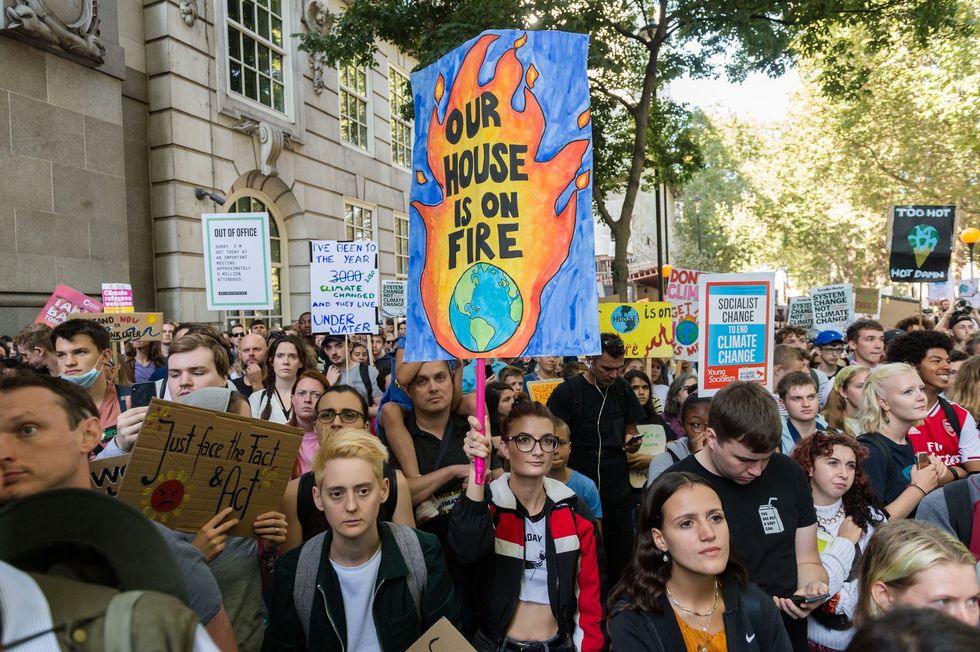
When Extinction Rebellion’s Roger Hallam faced criticism for claiming “six billion people will die this century as a result of climate change”, supporters pointed to the RCP 8.5 predictions to back him up.
But critics have long argued that the worst-case scenario painted an unrealistically bleak picture of the future because it relied heavily on unproven modelling data.
LATEST DEVELOPMENTS
- Alaska megatsunami caused by mountain collapse was second largest EVER on record
- Oxford physicists achieve world-first breakthrough in quantum physics
- Meteor shower to light up Britain this week as stargazers treated to ‘beautiful streaks'
They also said that it also assumed the world would massively increase its use of coal for the next 75 years.
Now the scientists behind the official UN climate modelling system appear to agree it no longer reflects reality.
They say that the worst case has been avoided because of climate policy and the lower costs of renewables.
Writing in journal Geoscientific Model Development, experts behind the models that will be fed into the next IPCC reports said that the old worst-case scenario would be dropped.
They wrote: “The scenarios should cover plausible outcomes ranging from a high level of climate change (in the case of policy failure) to low levels of climate change resulting from stringent policies.
“For the 21st century, this range will be smaller than assessed before: on the high-end of the range, the high emission levels (quantified by SSP5-8.5) have become implausible, based on trends in the costs of renewables, the emergence of climate policy and recent emission trends.”
Climate scientist Zeke Hausfather and climate researcher Glen Peters warned in 2020 that the scenario was being misunderstood.
Writing in Nature, they said: “RCP8.5 was intended to explore an unlikely high-risk future.”
But they warned it had been “widely used by some experts, policymakers and the media as something else entirely: as a likely ‘business as usual’ outcome”.
They added the scenario required “an unprecedented fivefold increase in coal use by the end of the century”.
Despite that, the scenario became hugely influential.
The new climate framework no longer includes an '8.5' scenario - instead, the highest future warming prediction has been replaced with a less extreme version that assumes lower emissions and lower warming.
However the scientists still warn the planet could warm by roughly 3C this century under a new high-end scenario -enough to bring climate disruption, rising seas and more extreme weather.
Such an increase could also wipe out coral reefs and put the Amazon rainforest at risk.
Energy analyst Michael Liebreich, founder of Bloomberg New Energy Finance, has spent years criticising use of the old scenario.
He has said in a previous interview: “Anyone with eyeballs can see the absurdity of RCP 8.5, which would require growing coal use 7x through to 2100.”
He also accused parts of the climate movement of relying too heavily on frightening worst-case scenarios.
“The tragedy,” he wrote, “is that the climate community spent two decades telling people we were heading for 4°C to 7°C of warming.”
Roger Pielke, professor of environmental studies at the University of Colorado Boulder, called the decision “an absolutely huge development in climate science”. He wrote: “The future is not what it used to be.”
Some scientists and commentators say the row exposes a bigger problem in climate communication.
Steven Koonin, former US Under Secretary for Science under President Obama, has argued that extreme scenarios often dominate public debate because they generate the most dramatic coverage.
He told GB News: “This is not at all a surprise - it’s the latest step in the ongoing retreat from climate alarmism to realism. Expect a similar climb down on claims about extreme weather events and on the benefits of wind and solar energy.”
Speaking to the Hoover Institution, Mr Koonin criticised what he called the “worst, worst, worst case climate projection”.
He said it assumed “that the world is going to massively increase consumption of coal in the future”.
Prof Koonin, former energy advisor to the US government, says the nuance was often lost once the scenario moved from scientific journals into political speeches and media headlines.
Scientists stress that climate scenarios are not predictions.
Instead, they are “what if?” exercises designed to explore how the climate might respond under different conditions.
Supporters of the old 8.5 pathway say it still had scientific value because it helped researchers study high-risk outcomes and prepare for worst cases.
Writing last year, Dr Hausfather said it was unclear whether the improvement in outcome was down to better climate policy or that fact that the original estimates were so high.
He wrote: “Ultimately, the degree to which the improvement in probable 21st century emissions outcomes was due to progress in driving down the costs of clean energy and climate policy interventions vs. implausible assumptions of high future emissions is to a large degree unknowable given its dependence on counterfactual assumptions.”
But he said that emissions had slowed notably and today’s world was a ‘different place’.
“It is hard to rule out the possibility that the 21st century could have ended up dominated by coal—as seemed much more plausible from the vantage point of the mid-2000s—even if it is clearly quite unlikely today,” he wrote.
Our Standards: The GB News Editorial Charter