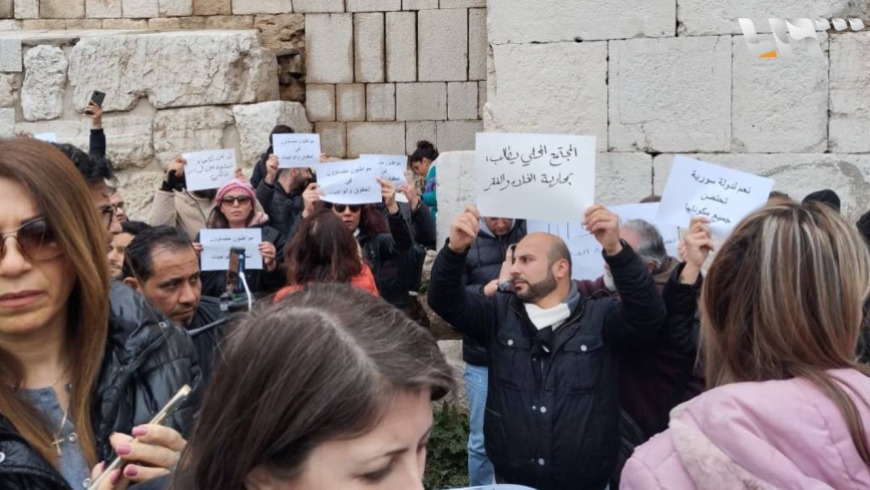
On Sunday, 22 March, the historic quarter of Bab Touma became the setting for a principled civic gathering as dozens of Syrian activists assembled to protest a recent decree issued by the Damascus Governorate. The administrative order restricts the sale of alcoholic beverages to the districts of Bab Touma, Al-Qassaa, and Bab Sharqi. Demonstrators denounced the measure as a discriminatory intervention that undermines the demographic and cultural character of these long-standing neighbourhoods.
In an official clarification released on Saturday evening, the Damascus Governorate defended the decision as an exercise of its legal mandate to safeguard public security, civil peace, and general decorum. Authorities insisted that the resolution does not encroach upon personal liberties and described it as an organisational measure grounded in existing legislation. Despite these assurances, the protest unfolded under the close watch of internal security forces and civil defence personnel. The gathering featured speeches that underscored national unity, communal coexistence, and the inviolability of individual freedoms.
Voices of Dissent and the Defence of Pluralism
Among the notable participants, actress Nora Murad affirmed that the Syrian Constitution remains the foremost guarantor of civil liberties. She argued that administrative inconsistency has no place in a society shaped by millennia of coexistence. Murad added that the enduring Syrian aspiration for freedom and dignity must remain untouched.
Dr Angela George Khoury expressed a similar view, explaining that her presence signified a rejection of any attempt to categorise Syrian regions along sectarian or social lines. This sentiment was echoed by Lubna al-Fayoumi, a postgraduate student, who described her participation as an essential expression of her right to speak. She noted that the issue extends beyond the regulation of alcohol sales and concerns the broader principle of individual autonomy and the collective pursuit of peace and social welfare.
The Gubernatorial Rationale and the Emerging Legal Dispute
The Governorate maintained that the decree is rooted in long-standing legislation, citing Legislative Decree No. 180 of 1952 and subsequent resolutions issued between 1998 and 2018. Officials argued that maintaining a prescribed distance between licensed premises and places of worship or education has been a consistent regulatory practice. They further justified the measure as a response to local complaints regarding noise, public disturbances, and the unregulated sale of alcohol to minors.
This reasoning has prompted significant legal scrutiny. Prominent lawyer Michel Shammas challenged the Governorate’s interpretation, asserting that Resolution 311 exceeds the bounds of executive authority. He noted that Legislative Decree 180 of 1952 governs taverns where alcohol is consumed on-site, yet contains no provisions concerning establishments that sell sealed containers.
The legal challenge centres on the principle that the original decree restricts such establishments only in neighbourhoods with a predominantly Muslim population, without granting the Governor the authority to designate specific zones at will. By expanding the scope of the original legislation, the administrative order is viewed by legal experts as a breach of constitutional hierarchy, effectively introducing new obligations without legislative foundation. Critics argue that any administrative act that departs from the established legal framework is inherently invalid and must be rescinded to preserve the rule of law.
This article was translated and edited by The Syrian Observer. The Syrian Observer has not verified the content of this story. Responsibility for the information and views set out in this article lies entirely with the author.
The post Civil Defiance in Damascus: Activists Gather in Bab Touma to Oppose Discriminatory Zoning Mandates first appeared on The Syrian Observer.