Agadir – Moroccan researcher Reda El Medaker has been nominated for the Raymond Vatier International Prize, one of the prestigious academic distinctions in the field of social audit and Corporate Social Responsibility (CSR), marking a milestone in his academic journey on a global level.
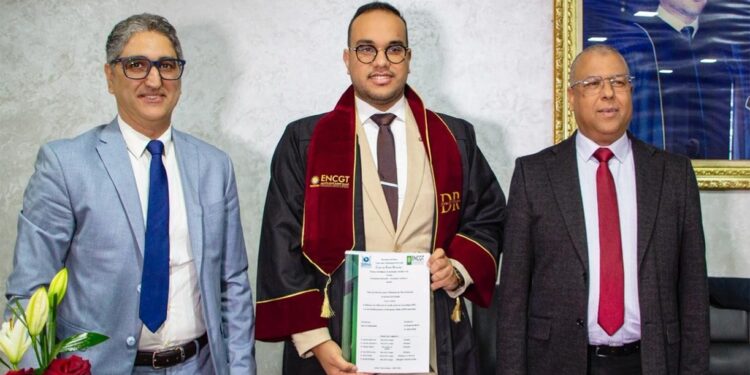
At just 27 years old, El Medaker has built a profile that combines many layers. He is a doctor, professor of higher education, researcher and the president of the youth committee of IAS Paris (IAS International Institute of Social Audit).
El Medaker has also received several distinctions, including Best Young African Researcher 2023 and a French award for originality of research topic.
Born in Goulmima, in the province of Errachidia, El Medaker’s trajectory reflects what he describes as a path shaped by perseverance and discipline in a region “where the harshness of the climate matches the warmth of its people.” This environment, he suggests, played a foundational role in developing the intellectual discipline that continues to define his work.
His academic path took a decisive turn in Meknes, where he joined the highly selective preparatory classes (CPGE). “It is in this arena of excellence that I discovered a true passion for Management and Human Resources (HR),” El Medaker told Morocco World News (MWN).
Afterwards El Medaker joined the National School of Commerce and Management (ENCG) in Tangier, specializing in Audit and Management Control. It was there that he began to articulate what would become his core intellectual project: bridging technical audit practices with human centered management.
From ‘cold’ audit to human centered impact
El Medaker spoke to MWN of his choice to bring a social or human-centered aspect to his academic discipline. As his speciality generally comes across as too technical or even “cold,” he explained, he made the choice of reframing the discipline through a social lens in a bid to both make it more interesting or engaging for the non-specialists and expand its scope.
“This choice appears technical, almost cold, and seemingly far from my initial love for HR,” yet through his research he combined the rigor of auditing and the sensitivity of human management.
“Auditing should not be limited to verifying figures; it must evaluate how an organization treats its human capital and its impact on society,” he shared with MWN.
This approach led him to focus on Social Auditing and Corporate Social Responsibility (CSR) as central to sustainable performance. “By presenting CSR as an ethical extension of performance, I demonstrated that employee well-being and social ethics are the true guarantors of long-term economic sustainability, particularly in Morocco’s public sector,” he added.
El Medaker’s nomination for the Raymond Vatier International Prize is closely tied to what he described as a “methodological breakthrough.” His work introduces a “bidirectional” approach that adapts CSR standards from major multinational corporations to the specific realities of public and private organizations.
“In my thesis, I extract the best CSR practices from the most high-performing multinational companies worldwide and adapt them to both private and public sectors. I adjusted these international standards while taking into account field realities: specific regulatory frameworks, budget constraints, and strategic objectives unique to each organization,” he explained.
“This methodology was first successfully tested on a representative sample in Morocco before crossing the Mediterranean. Currently, these models are being tested in France.”
This cross-border validation has been a key factor in strengthening the credibility of his work, transforming his thesis into what observers describe as a potentially “universal solution.”
El Medaker noted that his research demonstrated the ability to integrate every stakeholder, regardless of size, into the challenges of tomorrow’s economy. “I no longer simply represent the voice of a new generation; I prove that Moroccan expertise can now export ethical management solutions to Europe,” he said.
‘Do not endure conditions, transform them’
Through Morocco World News, El Medaker conveyed a message to young researchers. He argues that constraints should not be seen as barriers but as opportunities for innovation. “The academic journey should not be an ivory tower but a bridge toward those just starting out. Constraints should not be obstacles but drivers of creativity,” he argued.
“The researcher is not defined by the material or budgetary conditions in which they operate, but by their ability to transform these conditions into solutions, knowledge, and impact.”
He also encourages a shift away from purely theoretical work toward applied research that engages directly with real-world challenges. For him, doctoral students should not see themselves as passive learners but as active contributors: solution providers capable of influencing organizations and public institutions.
“Move beyond purely theoretical paths to embrace applied research – research that speaks to the core of businesses and public administrations,” he said.
International openness is another central theme he addressed, notably advising young researchers to actively seek opportunities beyond national borders. “Do not wait for opportunities to come, but seek them wherever they exist—through international networks, cross-border collaborations, or digital scientific-sharing tools,” he stressed.
For him, Moroccan research holds a unique advantage because “it offers a unique field of experimentation at the crossroads of international standards and emerging realities.”
Turning weaknesses into a boost
El Medaker further addressed the psychological dimensions of the research journey, highlighting the rollercoaster that researchers go through which has a great influence on their mental health.
“Every phase of doubt or vulnerability should not be seen as failure, but as an opportunity for necessary reflection,” he told MWN. “It is by learning to transform these emotional fluctuations into a creative boost that researchers develop endurance far beyond their thesis; it is in this alchemy that the leadership of tomorrow is forged.”
To El Medaker, doctoral students and young researchers ought to embrace the difficulty of the researcher’s journey while never losing sight of their original, motivating sense of purpose. For him, that purpose is to not just endure the journey, but to strive to produce socially relevant, impact, and transformational work.
“My dear colleagues, love your subjects and never endure your doctorate, live it as a conquest. This path is difficult, it is true, but your moments of doubt are your greatest allies: learn to turn them into creative energy,” he concluded. “Do not wait for perfect conditions to shine; it is up to you to transform your constraints into solutions and your passion into impact. The world does not wait for titles, it waits for your vision. So dare, because your only limit is yourself.”
The post Bridging Audit and Ethics: Reda El Medaker Rise to Global Academic Recognition appeared first on Morocco World News.