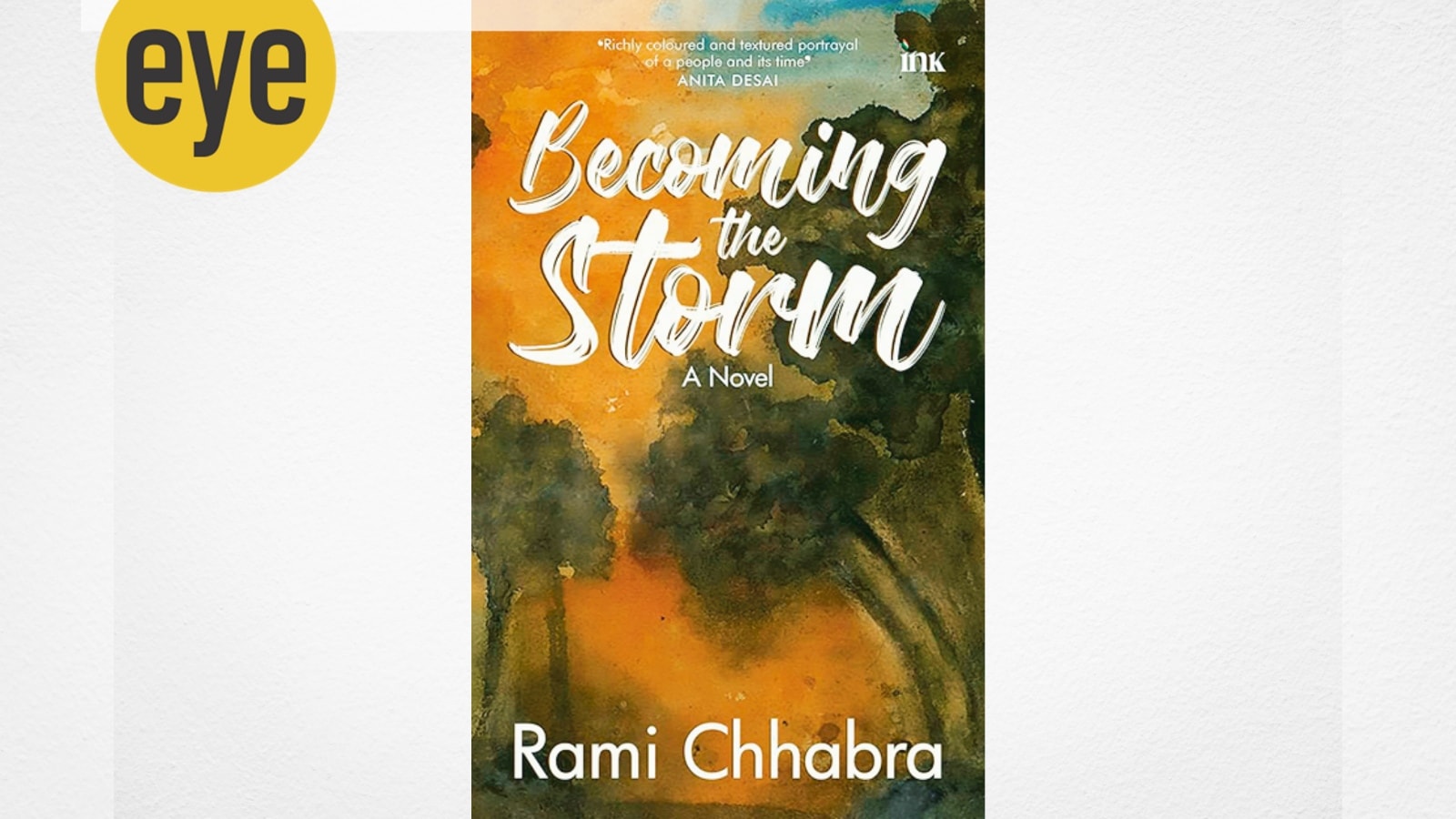
Weather ePaper Today’s Paper Journalism of Courage Home ePaper Politics Explained Opinion India Business Premium Cities UPSC Entertainment Sports World Lifestyle Tech Subscribe Sign In TrendingUPSC OfferIPL 2026US NewsPuzzles & GamesLegal NewsFresh TakeHealthResearch🎙️ Podcast Advertisement function checkAndLoadWindowSizeScript() { if (window.jQuery) { // jQuery is loaded, include your script jQuery(document).ready(function($) { // Your existing script for checking window width if (window.innerWidth) var page_w = window.innerWidth; else if (document.all) var page_w = document.body.clientWidth; if (page_w > 1024) { $(".add-left, .add-right").show(); } else { $(".add-left, .add-right").hide(); } }); } else { // jQuery is not loaded, check again after 0.2 seconds setTimeout(checkAndLoadWindowSizeScript, 200); } } // Initial call to the function checkAndLoadWindowSizeScript(); NewsBooks and LiteratureBecoming the Storm is a Delhi family saga on early marriage and women’s agency Premium Becoming the Storm is a Delhi family saga on early marriage and women’s agency Rami Chhabra’s debut novel turns decades of activism into fiction, tracing one woman’s life through post-Partition Delhi to examine patriarchy, prophecy and the long fight against early marriage Written by: Aishwarya Khosla3 min readNew DelhiUpdated: Apr 20, 2026 03:41 PM IST Book cover Make us preferred source on Google Whatsapp twitter Facebook Reddit PRINT There is something almost cosmically appropriate about the central scene of Rami Chhabra’s debut fiction, Becoming the Storm. A sant of considerable local repute arrives at a Delhi bungalow in a black imported Chevrolet; its mere presence in the driveway sufficient advertisement of divine connections. Sixteen-year-old Indu, spotting his fallen pen, bends to retrieve it. The sant, assuming devotion where there is only politeness, blesses her extravagantly and prophecies: marry at 18 and your karma is catastrophic; marry at 22 and you shall have a smooth life. Indu, who does not believe in sants, duly marries at 18. Reader, she regrets this. What follows across 474 pages is a post-Partition intergenerational Delhi family saga that Anita Desai has called sprawling and richly coloured. Desai, to be clear, is right. The Singhs are a proper novelistic family — feuding, loving, financially complicated, equipped with the full complement of difficult in-laws and possessed of the stereotypical mother-in-law who, upon meeting her newborn granddaughter, observes, “What to say. After all it’s only a girl.” The scenes are vivid, as only lived experience can make them; the dialogue feels lived-in; the domestic details give a sense of déjà vu and the social textures are uncomfortably familiar. The novel holds up a mirror to a society that would rather not be looked at directly, and keeps it there. The sant is the novel’s cleverest move — policy disguised as destiny, given that Chhabra spent decades arguing in policy papers that early marriage was destroying Indian women. That those papers changed very little is presumably why she eventually resorted to fiction. Chhabra herself has spent the better part of six decades being the woman her protagonist Indu wants to become. She broke into Indian print journalism when it was an all-male operation, founded Streebal in 1975, and has been fighting early marriage and dowry ever since. At 82, during the pandemic lockdown, she decided to write a novel to drive home the message. The dedication sets out the politics plainly: the novel is for women who have struggled and equally for “the many fine men who partner the change process.” That equally is the whole argument, impatient with a feminism Chhabra considers to have narrowed itself into irrelevance, while the real numbers barely moved. Indu fights for her dignity without forgetting her responsibilities and rendered throughout with the compassion of a writer who understands that the women who lived through this period did not have the luxury of rage as a lifestyle. Whether the execution sustains the ambition across the novel is a question for readers to settle for themselves. What is not in question is that Chhabra has earned this story in a way that most debut novelists do not. At 87, writing fiction for the first time, she brings to the form something no amount of talent alone can manufacture: the authority of someone who was there, argued about it for 50 years and still has not finished. Aishwarya Khosla is a senior editorial figure at The Indian Express, where she spearheads the digital strategy and execution for the Books & Literature and Puzzles & Games sections. With over eight years of experience in high-stakes journalism, Aishwarya specializes in literary criticism, cultural commentary, and long-form features that explore the complex intersection of identity, politics, and social change. Aishwarya’s analytical depth is anchored by her prestigious Nehru Fellowship in Politics and Elections. This intensive research fellowship in policy analysis and political communications informs her nuanced approach to cultural journalism, allowing her to provide readers with unique insights into how literature and media reflect broader political shifts. As a trusted voice for the Indian Express audience, she authors the popular newsletters, Meanwhile, Back Home and Books 'n' Bits, and hosts the podcast series, Casually Obsessed. Before her current role, Aishwarya spent several years at Hindustan Times, where she provided dedicated coverage of the Punjabi diaspora, theater, and national politics. Her career is defined by a commitment to intellectual rigor, making her a definitive authority on modern Indian culture and letters. Areas of Expertise Literary Criticism, Cultural Politics, Political Strategy, Long-form Investigative Features, and Newsletter Curation. Write to her You can reach her at aishwaryakhosla.ak@gmail.com or aishwarya.khosla@indianexpress.com. You can follow her on Instagram: @aishwarya.khosla, and X: @KhoslaAishwarya. Her stories can be read here. ... Read More
المصدر: Indian Express
| Source: Indian Express
ملاحظة تحريرية | Editorial Note:
نُشر هذا المقال في الأصل بواسطة Indian Express.
خبر (Khabr) هي منصة إعلامية أردنية مرخّصة تعمل بالذكاء الاصطناعي.
نضيف قيمة تحريرية من خلال: تحليل ذكي للأخبار، ملخصات تلقائية، رواية صوتية بالذكاء الاصطناعي، ترجمة متعددة اللغات، وتدقيق الحقائق.
هدفنا جعل الأخبار أكثر وضوحاً وسهولةً للقارئ العربي.
This article was originally published by Indian Express.
Khabr is a licensed Jordanian AI-powered news platform (Registration #82086).
We add editorial value through: AI-powered news analysis, automated summaries, AI audio narration, multi-language translation (Arabic, English, French, Turkish), and AI fact-checking.
Our mission is to make news more accessible and understandable for Arabic-speaking audiences worldwide.