Algeria Hijacks Pope Leo’s Visit to Peddle a Separatist Cause No One Is Buying
•Marrakech – It is not strange, nor remotely surprising, that a military junta which has spent half a century bankrolling a separatist phantom state – even at the obscene expense of its own citiz...
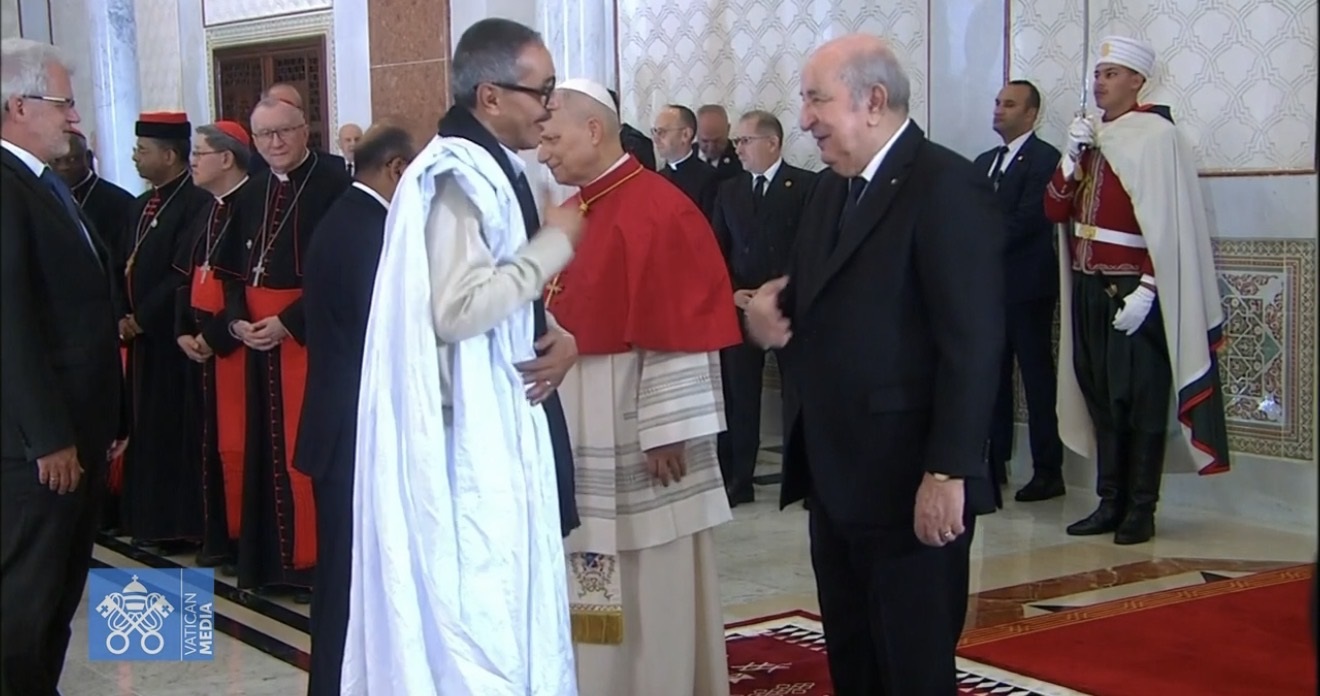
•On Monday, Algerian President Abdelmadjid Tebboune did exactly that: he paraded Khatri Adouh, the Polisario Front’s representative in Algiers, before Pope Leo XIV during the pontiff’s official welcome...
•The pope was conducting the opening leg of an 11-day African tour set to take him to Cameroon, Angola, and Equatorial Guinea.
هذا الخبر من Morocco World News. خبر يقدم أدوات ذكاء اصطناعي للتلخيص والترجمة والاستماع.
المصدر: Morocco World News | Source: Morocco World NewsMarrakech – It is not strange, nor remotely surprising, that a military junta which has spent half a century bankrolling a separatist phantom state – even at the obscene expense of its own citizens’ welfare, freedoms, and futures – would stoop to weaponizing a papal visit for cheap propaganda.
On Monday, Algerian President Abdelmadjid Tebboune did exactly that: he paraded Khatri Adouh, the Polisario Front’s representative in Algiers, before Pope Leo XIV during the pontiff’s official welcome ceremony, granting a fringe separatist operative a privilege denied to scores of accredited foreign ambassadors.
The pope was conducting the opening leg of an 11-day African tour set to take him to Cameroon, Angola, and Equatorial Guinea.
Analyzed closely, this stunt was not diplomacy. It was a ventriloquism of a regime moving the mouth of its puppet before the world’s cameras, hoping someone, somewhere, might still mistake the performance for legitimacy.
Algeria’s compulsive need to insert the Polisario into every conceivable forum – diplomatic, sporting, religious, ceremonial – has long since crossed the threshold from advocacy into pathology. It is the geopolitical equivalent of a man drowning who clutches at passing debris: the United Nations General Assembly podium, African Union corridors, continental football tournaments, and now the sacred space of a papal reception.
No venue is too solemn, no occasion too unrelated, for Algiers to shove its separatist proxy into the frame. The Arabic proverb rings devastatingly true: “A monkey is a gazelle in its mother’s eyes,” and Algeria, bereft of a viable diplomatic cause, fills every doorway it finds with thorns – the Polisario’s wilted banner.
Yet what Tebboune’s theatrical introduction spectacularly failed to acknowledge is the accelerating international burial of the very cause he was attempting to resuscitate. UN Security Council Resolution 2797, adopted on October 31, 2025, represented a seismic and irreversible shift.
For the first time, the Security Council explicitly designated Morocco’s 2007 Autonomy Plan as the basis for negotiations, recognizing that “genuine autonomy could represent a most feasible outcome.”
The resolution passed with 11 votes in favor; Algeria did not even participate in the vote – a diplomatic desertion that spoke louder than any speech its representatives could have delivered.
Meanwhile, the hemorrhage of recognitions for the self-proclaimed Sahrawi Arab Democratic Republic (SADR) has become an avalanche. Bolivia suspended recognition in February. Mali – an Algerian neighbor – withdrew recognition just days ago, on April 10. Panama, Ecuador, Peru, and a cascade of African and Latin American states have abandoned ship.
From over 80 recognitions in the 1980s, the Polisario’s roster of supporters has shriveled to a geopolitically marginal rump that would struggle to fill a single committee room at Turtle Bay.
‘I am not a politician’
Even before setting foot on Algerian soil, as if blessed with prophetic foreknowledge of what awaited him, the Pope delivered the most fitting rebuke to Tebboune’s maneuver without uttering his name.
“I am not a politician,” Leo XIV told journalists aboard the papal plane as though he had smelled the stunt before the wheels touched the tarmac. “I do not see my role as that of a politician, and I do not want to enter into a debate.”
He spoke of the Gospel, of peace, of ending wars – not of legitimizing separatist movements that exist only on the life-support machinery of a petrodollar-fed military apparatus.
If Polisario partisans on social media rushed to interpret the fleeting handshake as “implicit Vatican recognition,” reality offers a merciless corrective: the Holy See’s own 2025 informative note on diplomatic relations lists 184 sovereign states with which the Vatican maintains formal ties. The self-styled SADR does not appear – not as a state, not as an observer, not as a footnote. The Vatican’s diplomatic registry is exhaustive. The Polisario’s absence from it is absolute.
The grotesque irony of Algeria positioning itself as a host of interfaith dialogue and civilizational bridge-building deserves particular evisceration. In 2019, when Pope Francis – who passed away on April 21, 2025 – visited Morocco at the invitation of King Mohammed VI, Commander of the Faithful, Algerian state media and its electronic battalions unleashed a venomous campaign denouncing the visit as “betrayal” and “normalization.”
Morocco, where mosques, churches, and synagogues have coexisted since time immemorial, hosted a papal visit that produced a historic Jerusalem Declaration, a visit to the Mohammed VI Institute for Imam Training, and an interfaith musical performance that moved the world.
Algeria attacked it. Seven years later, the same regime now drapes itself in the garments of tolerance and coexistence it once tried to shred – a hypocrisy so brazen it would make Machiavelli blush. As the Arabic proverb goes: “One who lacks something cannot give it.”
Algeria’s welcome gift to the Pope: Suicide bombers
And what of the Algeria that greeted the Pope on Monday? As Leo XIV touched down on the land of Saint Augustine, preaching peace and reconciliation, two suicide bombers detonated explosive belts in Blida, barely 50 kilometers south of the capital. A French diplomatic source told Le Monde the connection between the attacks and the papal visit was “absolutely certain” – the bombers sought to punish Algeria for “welcoming the leader of the infidels” on Islamic soil.
Algerian authorities responded not with transparency but with their reflexive weapon of choice: a total information blackout. No official statement. No domestic media coverage. The African Union Commission initially condemned the attacks, then deleted its own statement – allegedly at the behest of Algerian military intelligence.
The ghosts of Algeria’s “dark decade” – the 1990s civil war that devoured between 100,000 and 200,000 lives – never truly departed. They merely learned to wait. Blida, the epicenter of Monday’s bombings, sits at the heart of what was once the “triangle of death,” the GIA’s bloodiest corridor. Islamist militancy in Algeria was never eradicated; it was wallpapered over with amnesty deals and classified files.
This is the country that presumes to lecture the world on self-determination. This is the regime that spends its sovereign wealth propping up a separatist front that the international community is abandoning in droves, while its own citizens endure repression, information blackouts, and the ever-present specter of terrorism it claims to have vanquished.
Algeria did not introduce the Polisario to the Pope. It introduced itself – its desperation, its duplicity, and the terminal bankruptcy of a foreign policy built entirely on someone else’s land dispute. The world watched. The world saw through it. And the cause Algiers tried so clumsily to resuscitate on a Vatican red carpet is no less dead today than it was yesterday.
Read also: Polisario Front Abandons Independence Ultimatum Under US Mediation Pressure
The post Algeria Hijacks Pope Leo’s Visit to Peddle a Separatist Cause No One Is Buying appeared first on Morocco World News.
ملاحظة تحريرية | Editorial Note: نُشر هذا المقال في الأصل بواسطة Morocco World News. خبر (Khabr) هي منصة إعلامية أردنية مرخّصة تعمل بالذكاء الاصطناعي. نضيف قيمة تحريرية من خلال: تحليل ذكي للأخبار، ملخصات تلقائية، رواية صوتية بالذكاء الاصطناعي، ترجمة متعددة اللغات، وتدقيق الحقائق. هدفنا جعل الأخبار أكثر وضوحاً وسهولةً للقارئ العربي.
This article was originally published by Morocco World News. Khabr is a licensed Jordanian AI-powered news platform (Registration #82086). We add editorial value through: AI-powered news analysis, automated summaries, AI audio narration, multi-language translation (Arabic, English, French, Turkish), and AI fact-checking. Our mission is to make news more accessible and understandable for Arabic-speaking audiences worldwide.