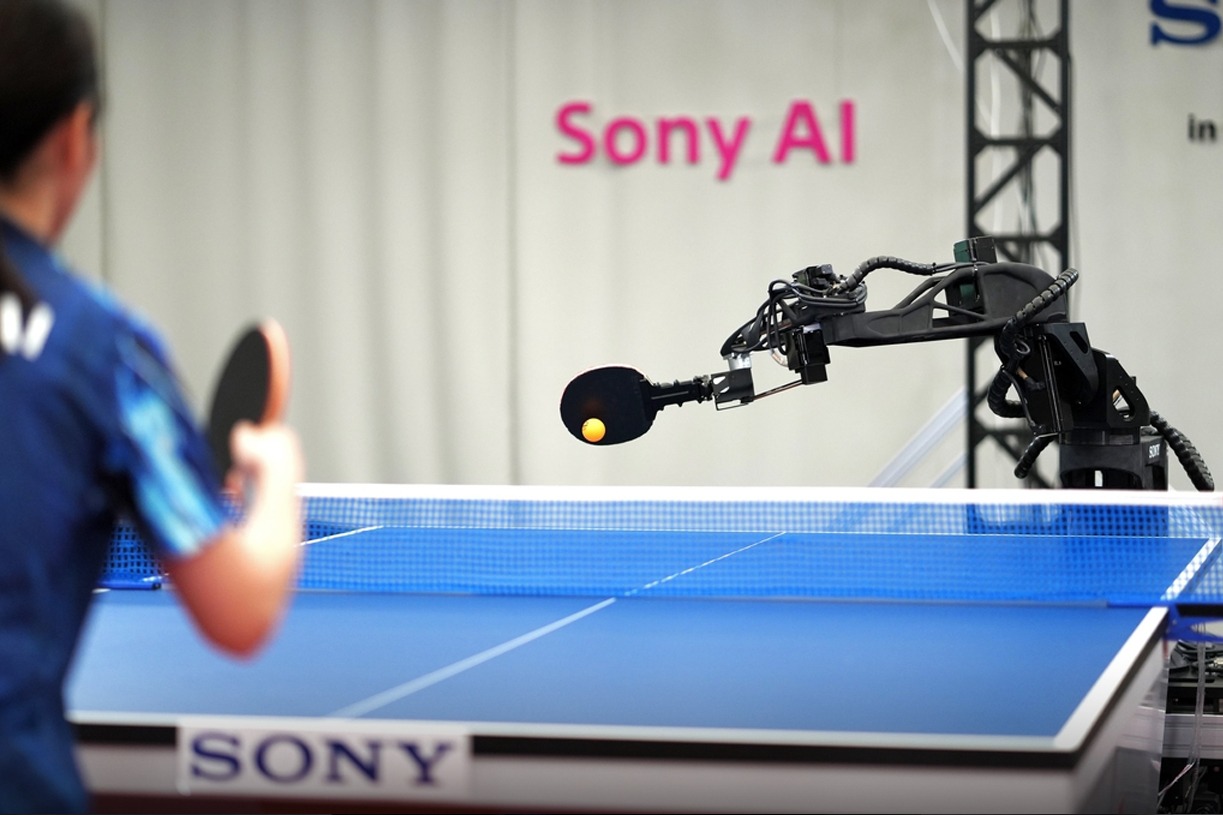
Tetouan – A table tennis robot developed by Sony has reached a new milestone in artificial intelligence, after successfully competing against, and in some cases defeating, professional players in a fast-paced physical sport.
The robot, known as Ace, was designed by Sony’s AI research division and is described by project leaders as the first system to achieve professional-level performance in a real-world competitive sport that demands both rapid decision-making and precise physical execution.
Unlike previous AI successes in digital environments, such as strategy games, table tennis presents a complex challenge.
It requires real-time interaction, accurate motion, and the ability to respond within fractions of a second, often at the limits of human reaction time.
Researchers say Ace overcomes these challenges through a combination of high-speed perception, advanced control algorithms, and a sophisticated robotic system.
According to Aljazeera , the robot demonstrated strong performance against elite players under official competition rules.
In controlled matches, Ace won three out of five games against high-level competitors and narrowly lost two matches against top-tier professional players.
Since then, Sony reports further improvements, with the robot securing additional wins against professionals in late 2025 and early 2026.
The system relies on a custom-built robotic platform with eight joints, considered the minimum required to replicate competitive strokes.
These joints control the position, angle, speed, and force of each shot.
Ace is also equipped with nine synchronized cameras and multiple vision systems, allowing it to track the ball with exceptional accuracy, including its spin and trajectory, at speeds that are difficult for the human eye to process.
Researchers note that the robot’s learning process differs significantly from that of human players.
Instead of studying human behavior, Ace trains itself through simulation, developing its own strategies and responses.
This approach has led to unpredictable playing patterns, which professional athletes say can be difficult to read.
Professional player Mayuka Taira, who lost a match to the robot, said its lack of emotional cues makes it especially challenging to anticipate its next move.
“You cannot sense what it struggles with or what kind of shots it prefers,” she noted, describing the experience as more demanding than playing against a human opponent.
Another professional, Rui Takenaka, who both won and lost matches against Ace, noted how the robot adapts to different playing styles.
He observed that complex serves are often returned with equally complex spins, while simpler serves produce more predictable responses creating opportunities for strategic play.
Researchers believe the technology behind Ace could extend beyond sports.
Its ability to combine rapid perception with precise control may have applications in industrial robotics, service systems, and other environments that require safe and responsive interaction with humans.
The achievement marks a significant step in bringing AI into dynamic physical settings, an area that has long remained more difficult than digital competition.
The post AI Robot Challenges Professional Players in Table Tennis Breakthrough appeared first on Morocco World News.