Something remarkable happened in African football on March 17, 2026. For once, a continental institution looked at its own rulebook, took a deep breath, and delivered a verdict that the evidence demanded, without flinching and without favoritism. Senegal had forfeited the AFCON 2025 final by walking off the pitch in protest during the closing minutes of the match, The CAF Appeal Board determined, ruling this meant a 3-0 win for Morocco. Within hours of the verdict, the narrative machine cranked into gear. Corruption. Conspiracy. Morocco pulling strings behind closed doors. Africa being robbed in broad daylight.
Let us be completely honest with ourselves, as Africans. That reaction tells us far more about our unresolved wounds than it does about what actually took place in Rabat.
What the regulations say, and what Senegal did
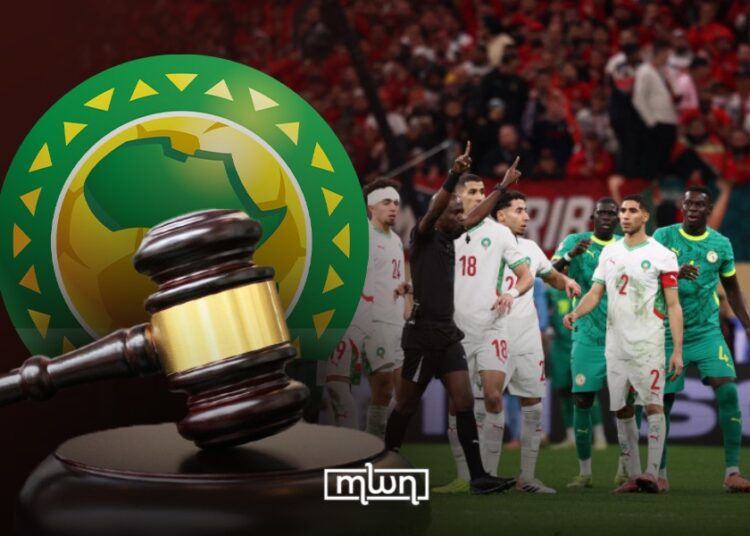
First and foremost, let us deal with the facts, because the facts are not in serious dispute. Angered by a series of refereeing decisions that culminated in a penalty awarded to Morocco in stoppage time, Senegal head coach Pape Thiaw ordered his players off the pitch. The match was suspended for fourteen minutes before play resumed, during which time fans invaded the field and clashed with both Moroccan supporters and police. Captain Sadio Mane eventually persuaded his teammates to return. Brahim Diaz stepped up and missed the penalty. Senegal went on to win 1-0 in extra time.
What happened next, however, cut even deeper. The head of CAF’s referee committee came forward and publicly acknowledged that his institution had wronged Morocco. Officials had instructed the referee not to bring the match to an end when they should have done exactly that, he revealed. That admission was a turning point, and it became one of the central pillars of Morocco’s appeal.
CAF’s appeals board cited Article 82 of the tournament regulations, which states that if a team is considered as losing a game if it refuses to play or leaves the ground before the end of the match without the authorisation of the referee. Morocco had lodged its appeal on precisely that ground, and it was upheld. The Moroccan football federation, for its part, was admirably clear about what it was asking for. It stated that its appeal was never intended to challenge the sporting performance of the teams, but solely to request the application of the competition’s own regulations.
Now, there is a legitimate and genuinely complex debate to be had here. Reasonable people can argue about whether CAF applied its regulations consistently, whether the referee ought to have acted on the spot, and how this verdict sits alongside established footballing principles. Those are serious questions, and they deserve serious answers. The Court of Arbitration for Sport will, in due course, have its say, and Senegal is absolutely right to pursue every legal avenue available to it.
But there is another conversation happening altogether, and it is considerably less serious. It is the one in which Morocco is portrayed as a puppet master quietly manipulating African institutions from behind the scenes. The one in which CAF’s ruling is perceived as fresh proof that the continent’s governance is irredeemably rigged against black Africans. That conversation is not an argument. It is a wound dressed up as an argument, and we should have the courage to call it what it is.
Morocco is Africa. That should not need saying.
The Casablanca group, composed of Ghana, Guinea, Mali, and Morocco, was among the foremost architects of the Pan-African unity movement in the early 1960s, pushing for political unity and continental integration among independent African states. Morocco was a founding signatory of the OAU, established in Addis Ababa in May 1963, alongside thirty-two African states whose central aim was to bring African nations together and eradicate colonialism from the continent.
That is not a footnote tucked away at the back of a history book. It is a foundational fact. Morocco was part of Pan-Africanism before Pan-Africanism had an institutional home. King Mohammed V stood before the world and called, clearly and without hesitation, for the liberation of colonised Africa. His successor, King Hassan II, made Morocco a refuge and a partner for liberation movements across the continent, including the African National Congress during its long and painful struggle against apartheid in South Africa. Let us not forget, either, that Morocco was itself a colonized nation. Its land was carved up between France and Spain. The city of Tangier was placed under international administration as though Moroccans did not exist. Its people were subjected to the same European contempt that left deep scars across the entire continent.
To tell Morocco it does not belong to Africa is not Pan-Africanism. It is, quite simply, a negation of history. And frankly, it is a form of discrimination that Africa’s proud intellectual tradition should have absolutely no patience for.
Beyond politics and beyond history, Morocco is Africa in the most tangible, lived sense of the word. For centuries, Moroccan merchants, scholars, and pilgrims have moved southward through the Sahara and deep into West Africa, building trade networks, spiritual ties, and cultural exchanges that long predate the colonial borders that were imposed on the continent in 1884. To this day, Morocco remains one of the largest African investors on the continent. It has consciously positioned itself as a bridge between North and West Africa, between Africa and Europe, and increasingly between the Global South and the corridors of global governance. That is not the posture of a country turning its back on Africa. That is the posture of a country betting on Africa’s future.
The success of AFCON 2025 was Africa’s success, not Morocco’s alone
Let us give credit where it is firmly due. AFCON 2025 was a genuinely exceptional tournament. Morocco built world-class infrastructure, filled its stadiums to capacity, delivered flawless organization, and welcomed African nations with the warmth and generosity of a host that truly understood the weight of the occasion. The final itself, chaos and controversy notwithstanding, was watched by hundreds of millions of Africans across the continent and the diaspora. The global visibility of African football grew in ways that will benefit the game for years to come. The argument that Africa can host elite international sport, and host it magnificently, was made more convincingly than ever before.
That success belongs to all of Africa, not only to Morocco. And yet, some voices, particularly those amplified by Algeria’s state and state-aligned media, spent the entire duration of the tournament running a relentless campaign to undermine every single Moroccan achievement. When Morocco won matches, it was suspicious. When Morocco’s infrastructure impressed visitors, it was called propaganda. When Morocco reached the final, the referees were suddenly to blame. This is not genuine criticism. It is a political project dressed in sporting colours, and African citizens, who are sharper and more discerning than these voices give them credit for, ought to recognize it as such.
I will not pretend this did not sting personally. A close friend of mine from South Sudan, someone I studied alongside in England, posted on Facebook the words “AFCON cup for Africans,” as though Moroccans were somehow outside that definition. When I gently pushed back and asked whether Moroccans were not African, she replied that Morocco had tried to steal the cup and that Moroccans did not consider themselves African anyway. A mutual friend from Tanzania added that “God’s justice” had been served. Reading those posts was a genuinely painful experience, not because the disagreement surprised me, but because of how much history, how much shared struggle, how much common ground, had simply been erased from memory.
The deeper question: what kind of institutions do we want?
Here is where the conversation really matters, and here is where all of us, regardless of who we were cheering for in the final, need to slow down and think carefully.
The most important dimension of the CAF ruling is not Morocco versus Senegal. It never was. What is truly at stake is whether African institutions are capable of enforcing their own rules, consistently, impartially, and without caving to political pressure whenever a powerful member state raises its voice. For far too long, the honest answer to that question has been deeply disappointing. Decisions across African governance, in sport as in politics, have too often been shaped by factional interests, diplomatic calculations, and the gravitational pull of whoever shouts the loudest. The consequence has been a steady erosion of institutional credibility that harms every single African nation equally, including the ones doing the shouting.
When FIFA president Gianni Infantino, who was present at the match, condemned what he described as “unacceptable scenes” and stated that it is not right to leave the field of play in this manner, he was pointing to exactly this problem. African football simply cannot demand the respect of the world while tolerating the spectacle of a coach leading his players off the pitch in the dying minutes of a continental final. That is not the image of an emerging continent. It is the image of a continent that has not yet decided to hold itself to its own standards.
The Senegalese government’s response, denouncing the ruling as a manifestly erroneous interpretation of the regulations, leading to a grossly illegal and deeply unjust decision, and accusing CAF of undermining its own credibility and the legitimate trust that African people place in continental sporting institutions, is a political position that deserves a fair and respectful hearing. Senegal has every right to fight this through the proper legal channels, and we should all want those channels to function properly.
But it is worth pausing on the irony, because it is a significant one. The credibility of African institutions is undermined far more reliably by the refusal to apply agreed rules than by their application. If every unfavorable ruling is automatically recast as corruption, if every institutional decision that displeases a powerful state becomes evidence of a grand conspiracy, then African institutions will never develop the independence and moral authority they desperately need to serve this continent. That culture of reflexive, convenient doubt is, in truth, one of the most effective tools available to those who have always preferred to see Africa ungovernable.
Morocco is not your enemy. Weakness is.
Morocco in 2026 is not the Morocco that certain regional actors prefer to imagine, peripheral, dependent, and eager to drift away from its African identity. It is a country that has just hosted a landmark AFCON. It is the country that, in 2022, became the first African nation in history to reach the semi-finals of a FIFA World Cup, carrying an entire continent on its shoulders and making every African proud in the process.
It is a country building high-speed rail, scaling up renewable energy, and cultivating a diplomatic presence that carries genuine weight in rooms that once barely acknowledged Africa’s existence. It is a country preparing to co-host the 2030 World Cup. It is a country whose king has made African integration a consistent and sincere foreign policy priority, whose investment flows reach deep into the continent, and whose universities are training the next generation of African professionals, drawn from dozens of African nations.
None of this makes Morocco beyond criticism. No country is, and genuine African solidarity must always leave room for honest disagreement and rigorous accountability. But there is a meaningful difference between criticism and conspiracy. There is a profound difference between holding Morocco to account and denying its African identity altogether. And there is a world of difference between grieving a painful sporting loss and weaponizing that grief to feed a narrative that serves no one, except those who have always had a vested interest in keeping Africa fragmented, suspicious, and looking outward for someone else to blame.
The real obstacles to African progress are not the countries that build, compete, and insist on the application of their own rules. They are the forces, internal and external, that thrive on Africa’s inability to trust its own institutions, carry out its own decisions, and believe, truly believe, in its own capacity for justice.
CAF made a difficult, unprecedented, and legally grounded ruling. It will be tested, as it should be, before the Court of Arbitration for Sport. That process is not a threat to African institutions. It is how institutions grow stronger. But for those who reached, almost instinctively, for the language of conspiracy, there is one question worth sitting quietly with: what exactly are you defending? If the answer is not the integrity of African institutions and the continent’s right to govern itself with honesty and backbone, then our problems run considerably deeper than any football final.
Africa is better than this moment. And deep down, every honest African already knows it.
The post Africa Does Not Need Another Conspiracy. It Needs Justice appeared first on Morocco World News.