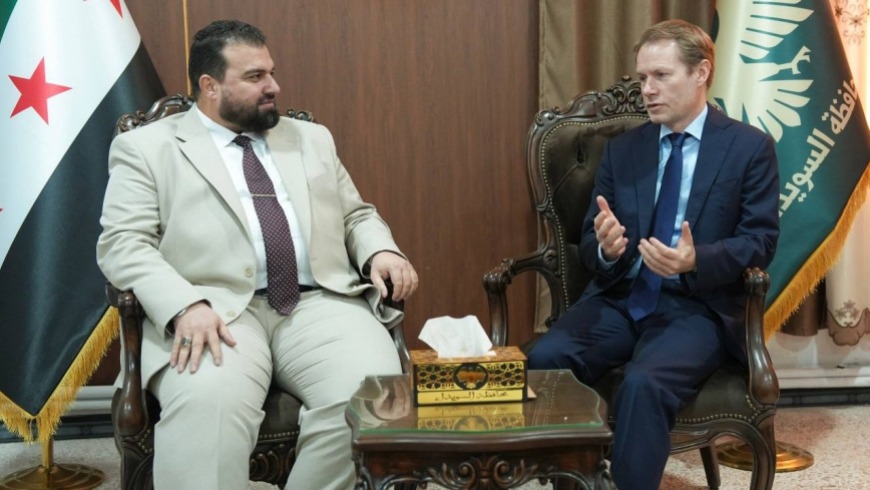
In a diplomatic gesture that signals a shift from distant commentary to direct engagement on the ground, the Governor of Suweida, Mustafa al-Bakour, received Jean-Baptiste Faivre, the Chargé d’Affaires of the French Embassy, on Thursday, April 3, 2026. Their meeting focused on security, regional stability, and the expanding possibilities of bilateral cooperation. The timing is notable. It coincides with official discussions about the imminent resolution of the “Suwayda file” and government efforts to address service disparities. The visit therefore hints at a French strategic posture that reaches beyond protocol and turns toward the intricate realities of the post-de-escalation landscape.
Before arriving in Suweida, Faivre met with leading religious figures in Jaramana, including Sheikh Abu Ahed Haitham Katbeh, as well as a range of civil society representatives. Reflecting on these conversations through the X platform, he described Jaramana as a vivid expression of Syria’s social diversity and noted that their discussions encompassed both the progress achieved and the challenges that continue to shape the transitional period. Throughout these encounters, the French envoy reiterated Paris’s commitment to Syria’s sovereignty and territorial integrity. The message is familiar, yet its delivery from within the province rather than from afar lends it a new weight.
From Political Advocacy to Granular Engagement
The visit represents a deliberate evolution in French policy toward Suweida, a trajectory that took shape during the province’s heightened tensions in 2025. In September of that year, the French Foreign Ministry was among the first to acknowledge the “roadmap” proposed by Damascus, describing it as a promising opening toward lasting de-escalation. Paris urged rapid implementation, sustained dialogue, and equal protection for civilians.
This approach reflects a broader French inclination to promote local pathways to resolution, linking security to justice and reconciliation. These themes gained prominence in early 2026. During a meeting in Paris on January 6 between the French and Syrian Foreign Ministers, Suweida was framed within a wider conversation on human rights and transitional justice. The French Foreign Minister underscored support for investigating violations against civilians in both the coastal regions and Suweida, presenting transparency as an essential foundation for rebuilding international confidence.
Paris has also woven local stability into its vision of a “New Syria,” connecting it to renewed international engagement in reconstruction. France expressed readiness to assist in economic recovery and development, welcoming the easing of American sanctions following the expiration of the Caesar Act. The French Foreign Ministry emphasized that both countries seek a stable and unified Syria, while recognizing the importance of reaching security understandings with Israel along the southern frontier and advancing negotiations between Damascus and the Syrian Democratic Forces.
Negotiating the Northeast and Working Through Parallel Channels
French influence extends into the dialogue between the SDF and the Syrian government. On February 14, President Emmanuel Macron held a private meeting with SDF Commander Mazloum Abdi on the sidelines of the Munich Security Conference. Abdi later remarked that the French President expressed a personal commitment to supporting ceasefire efforts. Observers view this as a French assertion of relevance in the northeast, particularly after the U.S. Embassy highlighted Washington’s central role in the January 30 agreements. At the same time, Syrian Foreign Minister Asaad Hassan al-Shaibani met with his French counterpart, Jean-Noël Barrot, to discuss peace initiatives and regional development.
Paris also relies on parallel diplomatic channels, especially in Beirut. On March 11, Iyad Hazza, the Syrian Chargé d’Affaires in Lebanon, met with French Ambassador Hervé Magro to discuss regional stabilization. Hazza then held a separate meeting with Lebanese leader Walid Jumblatt. Given Jumblatt’s longstanding ties to the Druze community in Suweida, the convergence of these diplomatic movements suggests a carefully layered French strategy that blends local engagement with regional mediation.
A Role in Ascendancy
Taken together, these developments reveal a French role that is gradually taking shape. Paris has moved from political declarations to the monitoring of justice and the cultivation of a field-level presence, signaling an ambition to influence the contours of the Syrian settlement process.
The emphasis on dialogue and local stability invites speculation that France may support nuanced forms of local administration that uphold the unity of the Syrian state while acknowledging the distinctive social and political character of Suweida. The pattern emerging from Paris, Beirut, and southern Syria suggests that France is positioning itself as an indispensable participant in shaping Syria’s future, using a moment of relative calm to establish a lasting diplomatic and political foothold.
This article was translated and edited by The Syrian Observer. The Syrian Observer has not verified the content of this story. Responsibility for the information and views set out in this article lies entirely with the author.
The post A French Imprint in Suweida: Is Paris Cultivating a Role in Southern Syrian Governance? first appeared on The Syrian Observer.