⚡ عاجل: كريستيانو رونالدو يُتوّج كأفضل لاعب كرة قدم في العالم●⚡ أخبار عاجلة تتابعونها لحظة بلحظة على خبر●⚡ تابعوا آخر المستجدات والأحداث من حول العالم●
AI اقتراحات ذكية
AI مباشر|--مشاهد مباشر
1,083,314مقال401مصدر نشط228قناة مباشرة4,114خبر اليوم
آخر تحديث:منذ 3 ثواني
A billion-dollar mirage: Do Ukraine’s new missiles match the hype?
•Backed by nearly $1 billion in contracts, Fire Point has risen on bold claims of deep strikes inside Russia.
•But how real is its success?
•In less than two years, a little-known Ukrainian startup has secured nearly $1 billion in state contracts, built one of the country’s most ambitious missile programs – and drawn the attent...
هذا الخبر من RT English. خبر يقدم أدوات ذكاء اصطناعي للتلخيص والترجمة والاستماع.
Backed by nearly $1 billion in contracts, Fire Point has risen on bold claims of deep strikes inside Russia. But how real is its success?
In less than two years, a little-known Ukrainian startup has secured nearly $1 billion in state contracts, built one of the country’s most ambitious missile programs – and drawn the attention of anti-corruption investigators.
A February article by Deutsche Welle and subsequent interviews with co-founder Denis Shtilerman have helped propel Fire Point into the European media spotlight, with bold claims about long-range strike capabilities deep inside Russia. But beyond the publicity, evidence of real-world effectiveness remains limited.
What, then, can these missiles actually do – and how serious a threat do they represent?
Fire Point: Sudden success
In 2025, Fire Point rapidly emerged as a leading name in Ukrainian missile manufacturing. Today, it stands out as one of the most dynamic yet secretive defense startups in Ukraine, specializing in the production of long-range drones and missiles. Initially, the company developed only cruise missiles, but now it also designs ballistic missiles.
Reports suggest that the startup launched with $1.5-$2 million invested by the founders themselves. However, in 2024-2025, the company secured government contracts worth approximately $1 billion, which is truly remarkable. Perhaps the answer to this mystery lies in the backgrounds of the founders?
At the helm of the company is Denis Shtilerman, the chief designer, founder, and majority owner (with a 97.5% share) of FP. He describes himself as a wealthy individual unafraid to invest his own money into the project. The co-founder is Yegor Skalyga (2.5% share) who previously headed a film industry company, suggesting ties to Ukraine’s Vladimir Zelensky and his Studio Kvartal 95. Irina Terekh, the technical director and co-owner of FP, joined the team in 2023. And lastly, there is… former US Secretary of State Mike Pompeo, who joined the advisory board in November 2025. Now that’s a smart move, considering the current situation in Ukraine.
High-ranking Ukrainian officials have actively promoted the company’s products. Zelensky referred to the FP-5 Flamingo as the “most successful” missile in Ukraine’s arsenal. The company also reportedly has ties to the former head of Zelensky’s office, Andrey Yermak. This is quite possible, since Fire Point has become the largest recipient of the Ukrainian Ministry of Defense’s budget allocations for the construction of drones. Shtilerman attributes this to the fact that some state enterprises maintain secret ties with Russia, which is unacceptable at this time.
However, the National Anti-Corruption Bureau of Ukraine (NABU) may have a different opinion about the company’s success. NABU has launched an investigation on several fronts: firstly, it is investigating possible price inflation for components used in FP-1 drones; secondly, NABU is examining the company’s connections with Timur Mindich and potential corruption schemes related to procurement through government structures. Amid these scandals, the appointment of Mike Pompeo to the advisory board has been viewed by many analysts as an attempt by FP to bolster its reputation and shield itself from corruption allegations.
FP indeed emerged out of nowhere and quickly became a leader in Ukraine’s drone and missile manufacturing sector. It specializes in the development and mass production of long-range FP-1 and FP-2 strike drones, as well as the FP-5 Flamingo cruise missile. By 2025, its workforce expanded to 3,500 employees, including 650 engineers, with production facilities covering 175,000 square meters across several secret locations.
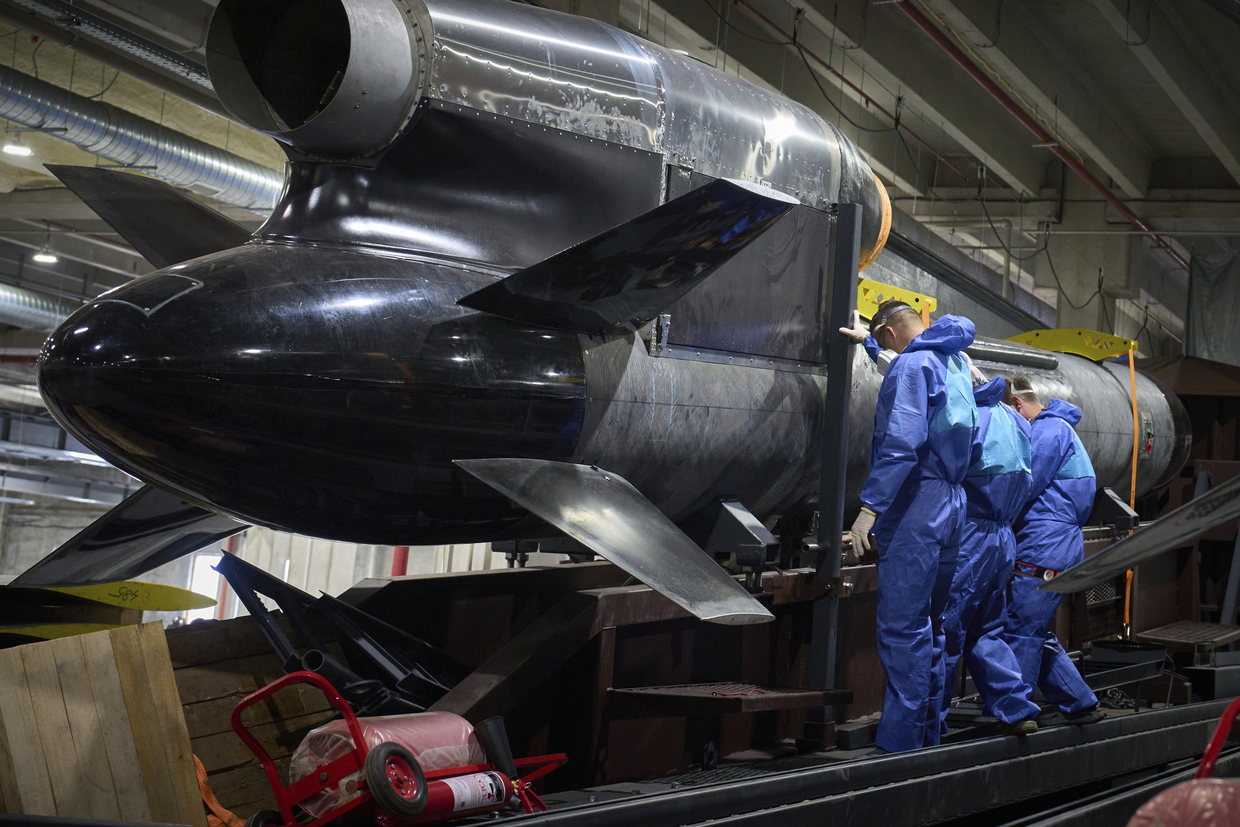
The company’s most notable product so far is the FP-5 Flamingo cruise missile powered by a AI-25TL turbofan engine. It is reported that the company has been gathering these engines from decommissioned training aircraft all over Eastern Europe. The missile is marketed as a long-range weapon designed for deep strikes. In size, it surpasses its Western counterparts like the Tomahawk or Storm Shadow missiles. Its flight range is up to 3,000 kilometers, and the warhead weighs 1,000-1,150 kilograms (with about 600 kilograms allocated for explosives). The missile travels at speeds of 850-900 km/h and has a launch weight of approximately 6,000 kg. The fuselage length is about 12 meters and the wingspan is six meters. Equipped with a relatively modern guidance system – a combination of an inertial navigation system and a jamming-resistant satellite navigation system – it boasts a reported accuracy of approximately 15 meters from the intended target. However, confirming these specifications in real-world conditions has proven challenging – it is unclear how many of the missiles have been launched and how many have failed during testing.
Fire Point had ambitious plans to ramp up production to 200 missiles per month by 2026, but apparently, these are still distant prospects. To create an illusion of ongoing missile production, news reports occasionally surface about the deployment of these missiles, often accompanied by video footage. It seems the company has allocated funds for PR, as multiple stories about FP have appeared in leading Western media outlets within the past month.
The effectiveness of the missiles remains unknown. Russia’s existing missile defense systems were all designed to counter more advanced and stealthy weapons like Tomahawks and Storm Shadows. So they can surely detect the bulkier Flamingo, especially since it flies at higher altitudes. Furthermore, indications suggest that the missile lacks any countermeasures and its design is rather straightforward. Shooting down such a missile shouldn’t pose a substantial challenge.
However, the Armed Forces of Ukraine (AFU) may hope to overwhelm Russian air defense systems if they manage to construct enough of these missiles. Currently, FP is struggling with producing a sufficient number, likely due to corruption issues or the difficulties of organizing production amid Russian airstrikes – likely, both issues are at play. Additionally, supplies of AI-25 engines aren’t infinite, and no one currently produces new ones. All this suggests that this ambitious program may remain largely theoretical, confined to paperwork and media headlines.
So why were the missiles named ‘Flamingo’? Most likely, a manufacturing error is to blame. According to the Associated Press, the first prototypes were mistakenly colored pink due to a simple error in mixing paint components during production. Whether the story is true or not, the name has stuck.
What’s next?
At the end of 2025, news emerged that Fire Point is set to produce FP-7 and FP-9 ballistic missiles, among other projects. The FP-7 is expected to replace ATACMS missiles and is predicted to boast a range of up to 300 kilometers. It will be equipped with a small warhead. The second missile will be larger, and will carry an 800-kilogram warhead capable of hitting targets at distances of 800-850 kilometers. Apparently, the AFU intends to use these missiles to strike cities like St. Petersburg and Moscow.
According to the available information, the company’s goal is to produce simple and efficient missiles. The design is based on surface-to-air missiles from Soviet-era S-300 systems. The company does not plan to produce hypersonic missiles, separating warheads, or missiles capable of evasive maneuvers. Modern missile defense systems should be able to intercept such missiles more effectively than GMLRS and ATACMS from the HIMARS system. However, ballistic missiles are undoubtedly more challenging to intercept than cruise missiles. Fire Point aims to roll out the production of ballistic missiles by 2026, with FP-7 already undergoing tests and possibly entering serial production in the coming months. FP-9 is expected to enter production by the end of summer.
But the company’s ambitions extend beyond strike systems. Fire Point has also outlined plans to develop a new air defense architecture, positioning itself as a potential provider of missile defense solutions for Europe.
The proposal includes claims of significantly reducing interception costs – from an estimated $6 million per Iskander missile today to roughly $1–1.5 million per intercept. These projections are being presented at an early stage, before the systems themselves have been designed or tested.
At the same time, the company has not demonstrated prior experience in developing or producing complex air and missile defense systems. Taken together, the emphasis on future efficiency and cost advantages may suggest that attracting investment is, at this stage, as central to the project as technological delivery.
Whether Fire Point can convert these ambitions into viable systems remains uncertain – particularly as its activities continue to draw the attention of anti-corruption investigators.
ملاحظة تحريرية | Editorial Note:
نُشر هذا المقال في الأصل بواسطة RT English.
خبر (Khabr) هي منصة إعلامية أردنية مرخّصة تعمل بالذكاء الاصطناعي.
نضيف قيمة تحريرية من خلال: تحليل ذكي للأخبار، ملخصات تلقائية، رواية صوتية بالذكاء الاصطناعي، ترجمة متعددة اللغات، وتدقيق الحقائق.
هدفنا جعل الأخبار أكثر وضوحاً وسهولةً للقارئ العربي.
This article was originally published by RT English.
Khabr is a licensed Jordanian AI-powered news platform (Registration #82086).
We add editorial value through: AI-powered news analysis, automated summaries, AI audio narration, multi-language translation (Arabic, English, French, Turkish), and AI fact-checking.
Our mission is to make news more accessible and understandable for Arabic-speaking audiences worldwide.
هذا الخبر ضمن تغطية خبر لقسم رياضة.
نقدّم لك تحليلات ذكية وملخصات يومية لأهم الأخبار من مصادر موثوقة متعددة.
المصدر: RT English.
يوجد 6 مقالات مرتبطة بهذا الموضوع.
This article is part of Khabr's coverage of Sports.
We provide AI-powered analysis, summaries, and multi-source aggregation to keep you informed.
Source: RT English.
Tags: Ukraine, missiles, military analysis.
خبر هو أول مجمّع أخبار عربي يعمل بالذكاء الاصطناعي. نقدم تحليلات ذكية وملخصات تلقائية ورواية صوتية لكل خبر من أكثر من 700 مصدر موثوق. نضيف قيمة تحريرية فريدة من خلال أدوات الذكاء الاصطناعي التي تساعدك على فهم الأخبار بعمق أكبر.
Khabr is the first AI-powered Arabic news aggregator. We provide AI-generated editorial analysis, automated summaries, audio narration, and fact-checking for every article from 700+ trusted sources. Our platform adds unique editorial value through AI tools that help you understand the news more deeply.
يا هلا! اسألني أي شي 🎤
🍪 نستخدم ملفات تعريف الارتباط لتحسين تجربتك وعرض الإعلانات المخصصة. باستخدامك للموقع، فإنك توافق على سياسة ملفات تعريف الارتباط وسياسة الخصوصية.
We use cookies to enhance your experience and show personalized ads. By using this site, you agree to our Cookie Policy and Privacy Policy.
🔍
FREEFree 1GB Internet + Free International Calls
$1 trial — eSIM in 190+ countries — No roaming charges