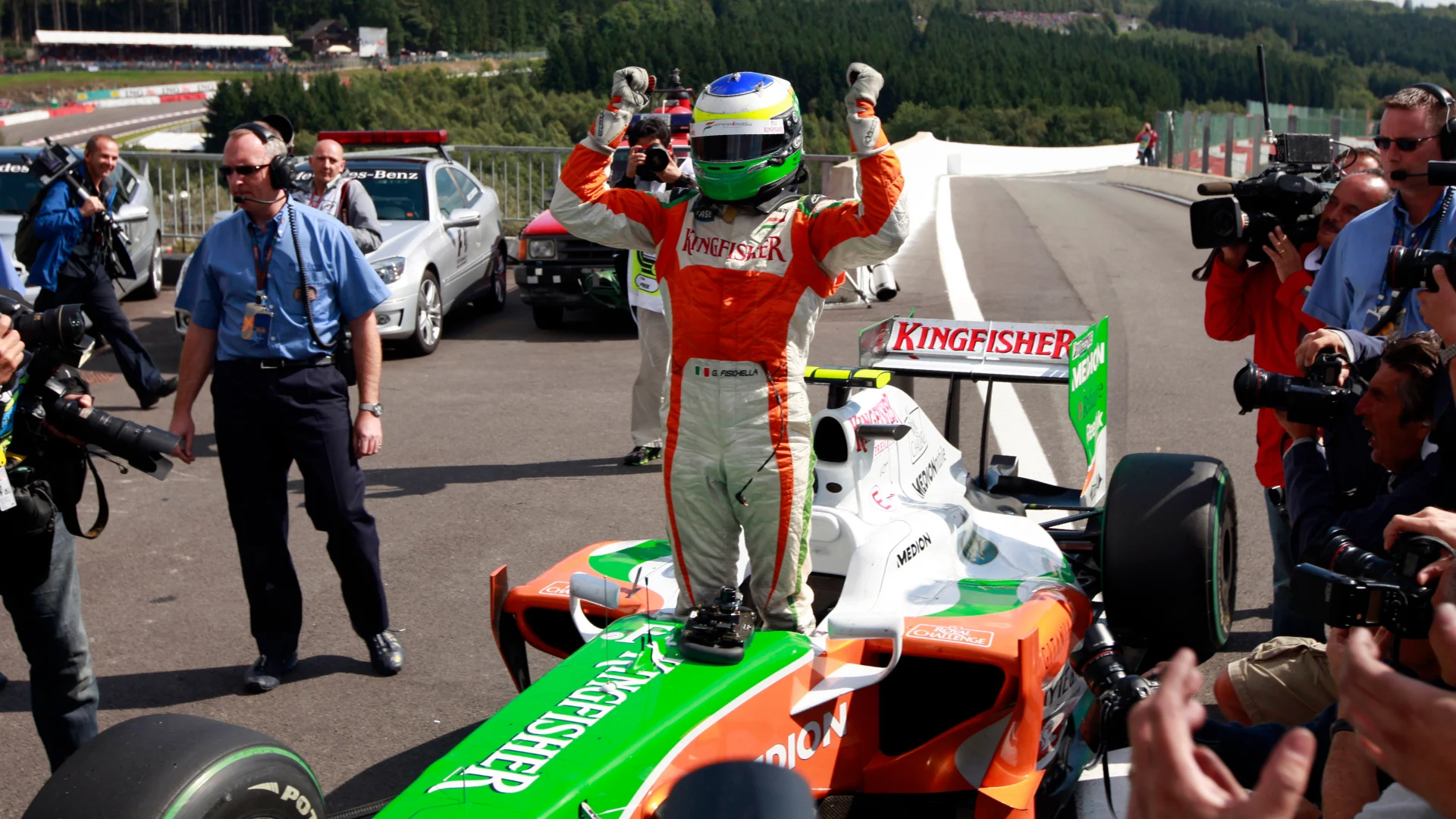
(opens in a new tab)Sign InSubscribeF1ScheduleChevron DropdownPrevious 2026 SeasonDriver Standings Team StandingsArchive 1950-2025F1 AwardsNewsChevron DropdownWhat is F1? What is F1 TV?F1 GlossaryGet involved2026 RegulationsNewsVideos8 times in-season development catapulted teams up the orderBettingWhy Hadjar offers betting value if Red Bull firesUnlockedJolyon Palmer builds his ultimate F1 team bossBettingHow to find value as Verstappen betting odds slidePlay11:32Isack Hadjar talks with Lawrence Barretto on his rise through the Red Bull ranks 21:56F1 drivers play the Generation Game Alexander AlbonFernando AlonsoKimi AntonelliOliver BearmanGabriel BortoletoValtteri BottasFranco ColapintoPierre GaslyIsack HadjarLewis HamiltonNico HulkenbergLiam LawsonCharles LeclercArvid LindbladLando NorrisEsteban OconSergio PerezOscar PiastriGeorge RussellCarlos SainzLance StrollMax VerstappenAll Drivers Hall of FameTeamsChevron DropdownAlpineAston MartinAudiCadillacFerrariHaas F1 TeamMcLarenMercedesRacing BullsRed Bull RacingWilliamsAll TeamsFantasy & GamingChevron DropdownF1 Sim RacingFantasyF1 25F1 Manager 24F1 PredictF1 ClashF1 Members' AreaMenuFIA if(window.f1MobileDetection.iOSSafari) { var meta = document.createElement("meta"); meta.name = "apple-itunes-app"; meta.content = "app-id=835022598, app-argument=https://www.formula1.com/en/latest/article/8-times-a-teams-in-season-development-catapulted-them-up-the-order.3tZtK9mEv6C7br2Ig4avGt.3tZtK9mEv6C7br2Ig4avGt"; document.head.appendChild(meta); } {"@context":"https://schema.org","@type":"NewsArticle","@id":"https://www.formula1.com/en/latest/article/8-times-a-teams-in-season-development-catapulted-them-up-the-order.3tZtK9mEv6C7br2Ig4avGt","url":"https://www.formula1.com/en/latest/article/8-times-a-teams-in-season-development-catapulted-them-up-the-order.3tZtK9mEv6C7br2Ig4avGt","mainEntityOfPage":"https://www.formula1.com/en/latest/article/8-times-a-teams-in-season-development-catapulted-them-up-the-order.3tZtK9mEv6C7br2Ig4avGt","datePublished":"2026-04-23T09:17:06.553Z","dateModified":"2026-04-23T09:17:06.553Z","headline":"8 times a team's in-season development catapulted them up the order","author":"F1","description":"F1.com has rounded up eight of the best zero-to-hero examples of teams timing their upgrades to perfection partway through a season.","image":{"@type":"ImageObject","url":"https://media.formula1.com/image/upload/f_auto/q_auto/v1776935652/fom-website/2026/Miscellaneous/16x9%20single%20image%20-%202026-04-23T101355.678.png"},"isAccessibleForFree":"true","publisher":{"@type":"SportsOrganization","@id":"https://www.formula1.com#organization","name":"Formula 1","logo":{"@type":"ImageObject","url":"https://www.formula1.com/etc/designs/fom-website/social/f1-default-share.jpg","width":"480","height":"120"}}}McLarenForce IndiaFerrariShow more tags8 times a team's in-season development catapulted them up the orderF1.com has rounded up eight of the best zero-to-hero examples of teams timing their upgrades to perfection partway through a season. The Miami Grand Prix is approaching fast, and teams up and down the F1 grid will have worked flat out in April to hone the design for their new-for-2026 cars. While Mercedes have been the class of the field so far this season, it's no secret that the development race – and who nails it – will have a massive impact on the pecking order as the year progresses. That's especially true with teams bidding to master the new rules. With that in mind we've taken a look at the greatest examples of in-season development, from McLaren’s charge to the podium in 2023 to Force India’s remarkable pole position back in 2009... McLaren have enjoyed a spectacular upward trajectory in recent years that few could have predicted back at the start of 2023 when Lando Norris finished last at the season opener in Bahrain, two laps behind winner Max Verstappen, while his rookie team mate Oscar Piastri was forced to retire with technical issues – far from the dream F1 debut. Points finishes were hard to find for McLaren, but with the technical team being shaken up ahead of the European leg, signs of potential slowly began to appear. At the Austrian Grand Prix, McLaren implemented their most significant upgrade package, which included new sidepods, a redesigned cooling system and aerodynamic adjustments. This propelled Norris to fourth place – a welcome result after placing 17th and 13th in Spain and Canada respectively – and encouraged the team to install the same changes on Piastri’s car. They would never look back from that point on as the Briton took his first podium of the year at Silverstone, kickstarting a fantastic run. After further upgrades in Singapore, they secured double podiums in Japan and Qatar and McLaren’s mighty turnaround was reflected in the Standings – in the first eight rounds, they had scored 17 points; over the following 14, they netted 285 points and nine podiums to take P4 in the Constructors’ Championship. Of course, they went on to be champions in 2024 and 2025. McLaren have an impressive record of surging from the back of the field to the front, something which Lewis Hamilton was especially grateful for in his third season with the squad in 2009. The situation didn’t look good from the outset as the MP4-24 suffered from aerodynamic problems that saw Hamilton and his team mate Heikki Kovalainen mingling at the bottom of the timesheets in pre-season testing. While Brawn GP and Red Bull got stuck into a somewhat unexpected battle for the title, McLaren found themselves with just 13 points at the midpoint of the season. After sealing the 2008 Drivers’ Championship by a single point over Felipe Massa, it was a shock to the system for Hamilton as he endured five rounds without scoring. The last of that run came at the German Grand Prix, where the team brought in major upgrades that helped their drivers qualify on the third row. A puncture sent Hamilton tumbling down the order, but it was evident that McLaren had taken a tantalising step forward. This came to fruition at the next round in Hungary as both drivers qualified in the top six once again before the Briton went on to win his first race of the season, which also made McLaren the first team to take victory with a KERS-equipped car. The days of bemoaning low-scoring weekends were long forgotten as Hamilton won again in Singapore and finished on the podium in Suzuka and Sao Paulo, enabling his team to secure third in the standings with 71 points. While McLaren had prior experience in competing for race wins, the same can’t be said for Force India. After scoring zero points in their debut season, their backmarker status had been confirmed and they elected to switch from Ferrari to Mercedes engines late in their development for 2009, with some key personnel also leaving due to conflicts within the team. With a brand new engine and various components provided by McLaren to get used to, drivers Giancarlo Fisichella and Adrian Sutil struggled significantly early on – they did come close to scoring, but incidents and tricky handling continued to deny the team their first points. Finally, after comprehensive upgrades, Force India made one of the most shocking improvements in F1 history – at the Belgian Grand Prix, Fisichella qualified on pole position before finishing the race in P2, only just missing out to Ferrari’s Kimi Raikkonen. The transformation from backrunner to podium contender was a thrilling one, and while the Italian was released to replace Luca Badoer at the Scuderia, Force India’s recovery continued at the following round in Italy as Sutil crossed the line in fourth place. They unfortunately suffered a downturn in performance in the final four events, but their magnificent improvement went down as one of the best instances of in-season development. Jordan began 1998 by poaching the 1996 World Champion Damon Hill from Arrows to complete their line-up as they retained Ralf Schumacher from the previous season. Things looked encouraging at first as the Jordan 198 car seemed to run well in testing, but the situation rapidly went downhill. The first half of the season featured a collective eight retirements and one disqualification as the pair found themselves unable to cope with understeer and an underperforming engine. With zero points on the board, Jordan had to make changes. They started off by working with Mugen Honda to develop the engine, and further adjustments to the suspension and front wing appeared to yield improvements, with Hill taking back-to-back P4 finishes in Germany and Hungary. By the time Jordan arrived at Spa-Francorchamps for Round 13, their resurgence was well and truly underway, but even they could not have anticipated the chaos that would ensue. Amid heavy rain and a 13-car pile-up, Hill and Schumacher stayed out of trouble to claim an exhilarating 1-2 finish for the team, which ultimately went a long way in helping them secure P4 in the Constructors' Championship. Ferrari’s 1998 turnaround isn’t quite as much of an underdog story. There was no big progression from zero points to a race win like Jordan, but their late challenge for the title was sensational in its own way. New regulations introduced a ‘narrow track’ era in F1, and while the Scuderia implemented a game-changing aerodynamic design that set them on course for dominance in subsequent years, it was McLaren’s Adrian Newey who mastered the latest changes early on. Such was McLaren’s superiority that Mika Hakkinen and David Coulthard lapped the entire field at the opening round in Australia, establishing what looked like an unassailable advantage over all of their rivals. However, at Round 7 in Canada, Ferrari brought a massive upgrade package that featured a new diffuser and front wing. This coincided perfectly with a hat-trick of victories for Michael Schumacher, and he finished the season with six wins overall. It wasn’t enough to beat Hakkinen to the title, with the German losing out in the finale due to stalling and picking up a tyre puncture at Suzuka, but the fact that he was even a contender was astonishing given McLaren’s initial edge. Determined to improve on the previous season, Williams’ design team opted to go back to the drawing board and introduce a carbon fibre monocoque, which had been pioneered by McLaren in 1981 and was gradually growing in popularity throughout the paddock. The refreshed FW10, piloted by Nigel Mansell and Keke Rosberg, was held back by a significant disadvantage – for the first part of the season, Williams used old Honda engines from previous seasons. They had been upgraded, but they proved to be no match for their competitors until they were replaced by brand new engines at the Canadian Grand Prix. Although the change initially paid off as Rosberg stormed to victory next time out in Detroit, their results continued to be inconsistent while the engine development carried on behind the scenes. Following a run of low-scoring rounds, Williams won the final three races of the season at Brands Hatch, Kyalami and Adelaide to tie Lotus for third place in the Constructors’ Championship, ushering in another golden era for the team. Engine development was crucial in Williams' 1985 seasonRenault (1981) Renault began the 1981 season firmly on the back foot as Alain Prost and Rene Arnoux trudged through the first five rounds in the RE20B, a modified version of the previous year’s challenger. The team weren’t content to stick with the same design so over time, they constructed the RE30, which ended up sharing very few similarities to its predecessor. A reworked chassis and gearbox combined with new aerodynamic components to produce a rapid car for newcomer Prost, who recovered from a slow start to the season to claim victories in France, the Netherlands and Italy. He and Arnoux also locked out the front row in Britain and shared six pole positions between them overall, although reliability troubles halted their chances of converting them to more than Prost’s three wins. Renault’s development enabled them to secure P3 in the Standings with 54 points, but it crucially set the stage for Prost – who went on to become one of the sport’s most legendary drivers – to secure his maiden win. Lotus’ Colin Chapman had turned heads with the Lotus 79, which perfected his ground effect concept and dominated the 1978 season when Mario Andretti and Ronnie Peterson scored 86 points between them, 28 more than their nearest rivals Ferrari. For that reason, you can’t really blame Williams for emulating it in their design of the FW07. Nevertheless, they used a non-ground effect car for the first four races and suffered concerning reliability problems, which ruled them out of any serious title challenge at an early stage. At the British Grand Prix (Round 9), the work of designers Patrick Head, Frank Dernie, and Neil Oatley came to fruition as Alan Jones secured a comfortable pole position – Williams’ first in what is now a long list of 128 – and his team mate Clay Regazzoni took the chequered flag over 24s ahead of Renault’s Arnoux. It marked a ground-breaking turning point for the team as they were close to unbeatable for the second half of the season, winning a further four races to surge to second behind Ferrari in the Constructors’ Championship. F1FacebookXInstagramYouTube© 2003-2026 Formula One World Championship Limited
المصدر: Formula 1 - فورمولا 1
| Source: Formula 1 - فورمولا 1