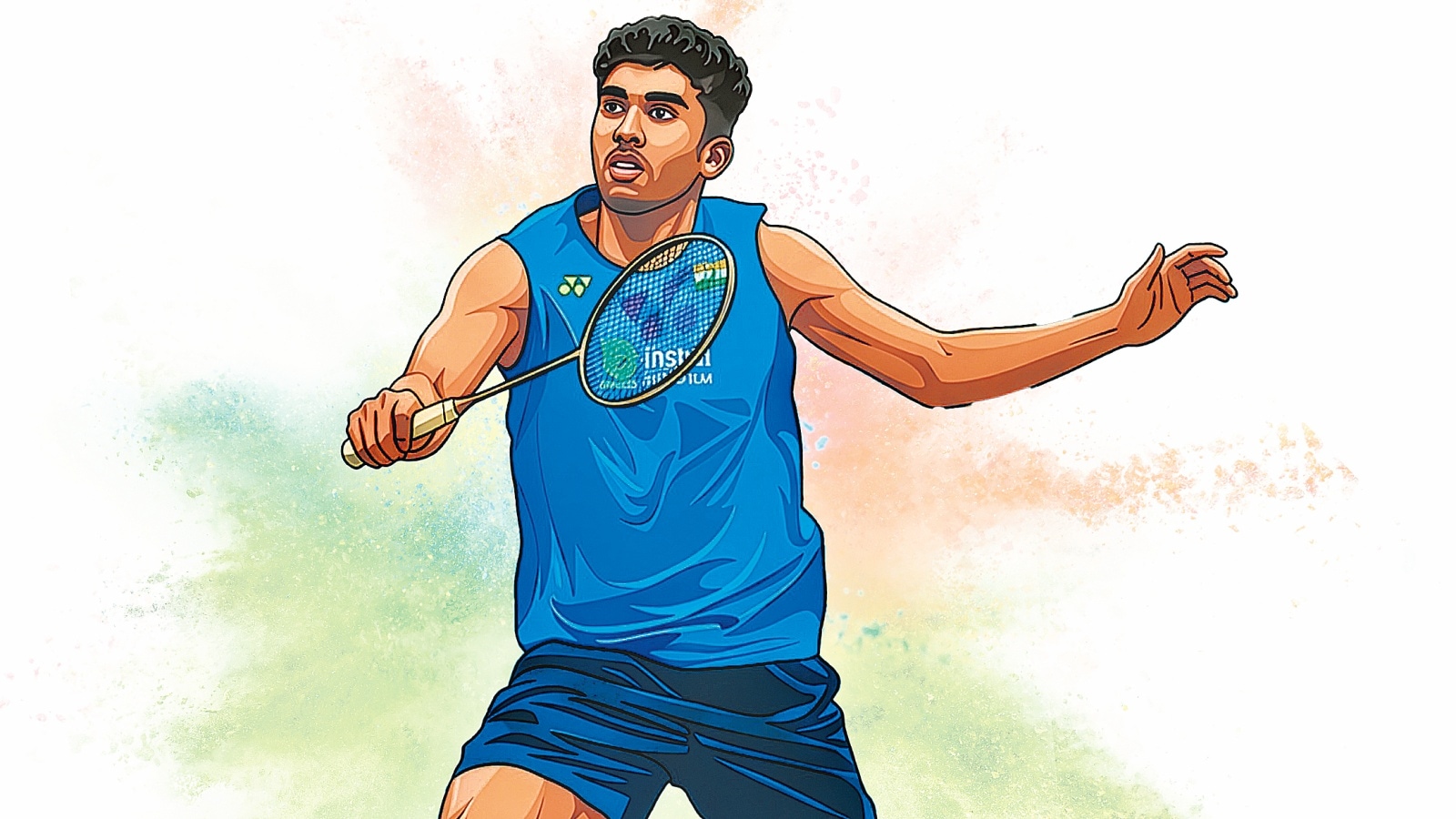
Weather ePaper Today’s Paper Journalism of Courage Home ePaper India Cities UPSC Premium Entertainment Politics Sports World Explained Opinion Business Lifestyle Tech Subscribe Sign In TrendingUPSC OfferIPL 2026US NewsPuzzles & GamesLegal NewsFresh TakeHealthResearch🎙️ Podcast Advertisement NewsLong Reads6’ 4’’ of power: Ayush Shetty as giant slayer The intensity for badminton grew after he won his first and only Tour title at the US Open in June 2025. As he traversed the globe playing tournaments, he would return home for 10 days a year. Premium 6’ 4’’ of power: Ayush Shetty as giant slayer As a child playing badminton, Ayush Shetty was talked about as much for his height as for his game. Then, with his mother solidly behind him, Ayush kept growing, kept playing. Shivani Naik on the player who smashed it at the Badminton Asia Championships, overpowering the World No 1 in the semifinals WHAT WIMBLEDON is to tennis, the All-England championship is to badminton. The slow, non-windy near-perfect conditions of the Birmingham bull-ring provide a formidable challenge to those chasing the coveted title. The reward is enticing: a silverware with a golden hue. For nearly 25 years, the Indians haven’t cracked the All-England code. Top stars have given their best but returned broken hearted. Lakshya Sen has tried twice, Saina Nehwal once, the rest —PV Sindhu, Srikanth Kidambi, Prannoy H S, the doubles pair of Satwiksairaj Rankireddy and Chirag Shetty — have all come undone. “It’s a tough one,” national coach Pullela Gopichand, the last to conquer the English challenge, had said last month. The bull-ring needed someone to ram through. “Someone needs to just barge in and go all the way — someone like Ayush Shetty,” Gopichand added. The wish wasn’t to be. Ayush Shetty lost in the first round at the All-England and was, until March, fending off poor form on the European swing, a series of Badminton World Federation tournaments held across Europe in the early part of the calendar year. Then, a month later, at the Badminton Asia Championships held in Ningbo, China, the 20-year-old was back, steamrolling past World No. 4 Jonatan Christie (Indonesia) and No. 7 Li Shifeng (China), before taking down reigning World No. 1 Kunlavut Vitidsarn of Thailand in the semifinals. His coach in Bengaluru, Vimal Kumar, had explained to The Indian Express how India’s own bull was razing down the China shop. “At any point, even when opponents build a rally against him, he has that one decisive big power smash that can help him end the rally and beat anyone. He is dangerous for every player because of that big hit,” Vimal said. A day after his loss in the finals to China’s Shi Yuqi, Ayush said from Ningbo, “I always knew I could defeat anyone. I like playing against the world’s best. I just need to be consistent. It’s not easy, but I have it in me.” While, as his finals loss showed, Ayush has much to learn, at least for the next five years, Indian badminton can dream of winning titles once again. “Opponents can find solutions to tactics and games. But they can do nothing with the power that comes from 6-foot-4, then the raised wing and then the soaring racquet,” said coach Vimal of his ward who will now jump to World No 18 from No 25 last week. Well before Ayush hit the bigtime of fame at Ningbo, a flock of people went visiting the nursing home where he was born. They weren’t fans, and this was no sporting pilgrimage to a hero’s origins. They were, in fact, zealous age-verification excavators — a group of mostly parents of fellow shuttlers in badminton-crazy Karnataka, who would scrutinise opponents in a sport where age-fraud was rife and losses got heated at the perceived unfairness. Ayush’s school, his local municipal corporation, neighbours, nothing and no one were spared as his documents underwent scrutiny. Reason? Ayush was always too tall for his age. “They would never believe,” she says of the suspicion surrounding his age that followed Ayush to all the junior tournaments. “They landed everywhere to check his age, even in the hospital where he was delivered,” recalls Ayush’s mother Shalmali, laughing at the memory. “All his documentation was in place. We had nothing to worry about. But it was really a problem. We had to carry his birth certificate to every tournament and convince them every time that it was his authentic age,” she says. Now, at 20, Ayush is happily 6-foot-4. As he scalps big names, he is making them aware of his massive wingspan, the stomping strides, flying reach and the blazing power in his smash. For far too long, the perfectly legitimate-aged shuttler had been tiptoeing around. But this last week, he strutted. So did Indian badminton. Ever since former Olympian Anup Sridhar, a towering 6-foot-2 shuttler, defeated the Indonesian great Taufik Hidayat at the 2006 World Championships, India has silently accepted power-play as the defining feature of its badminton. Anup, with a similarly imposing build but without a strong fitness base, went about unleashing smashes. Saina Nehwal, followed by P V Sindhu, H S Prannoy and finally, Satwik-Chirag have all stamped their power punch. Ayush went a step further. The shuttler from Karkala village in Udupi started playing badminton with his father and friends at age 8, “just for fun”. Cricket was the craze in Mangaluru and he played a spot of it with his friends. But badminton had his heart. Karnataka might holler “RCB, RCB” in unison, but shuttle is deeply popular in the state, with dozens of clubs in districts and at least 30 academies in Bengaluru. But back when Ayush started professional training, the nearest bare-basic academy was far away from his Karkala village. So Ayush would get ferried for training to Mangaluru city. “It was difficult, because Karkala is only a village,” recalls Shalmali. “We commuted 1.5 hours daily to Mangalore, about 40-50 km one way. It was getting hectic.” As Ayush started winning state-level tournaments, it was plain to see that he needed higher-level coaching. “The best players my age were training in Bangalore. I couldn’t stay home and do this,” Ayush recalls. It was time for his parents to make their toughest decision. “He was also topping at school. He was doing well, but wanted to do much better in badminton. So we took the biggest and hardest decision to pull him out of formal school and move to Bangalore,” she says. Since Ayush’s father ran a small business in Karkala, he stayed behind as Shalmali moved with their daughter and Ayush to Bengaluru. A homemaker, she took the plunge into the hyper-competitive world of parenting a 11-year-old badminton talent. The academy was 4 km away from where they lived, and morning sessions would start at 4.30 am. “It was almost a 24-hour job,” Shalmali recalls. “It was very tough. My daughter was just 3 years old then. She would be sleeping still, and I’d lock her up to go drop Ayush off for his 4.30 am session and then pick him up,” she says. Her own day would end around 7 pm, because Ayush also had tuitions as part of his open schooling. In Bengaluru, Ayush came to be noticed — not just for his game, but his height. But once he cleared the verifications, the age-checking brigade began to help him out and celebrated his wins as an endorsement of fair play. “Around 2015-16, some parents were concerned about Ayush, so we went to his hometown and checked every document. He was tall and winning a lot. We wanted to clean up age fraud in Karnataka. So he was thoroughly checked. We can vouch for him. Ayush, in fact, suffered himself, when he lost at a tournament outside the state to an opponent who was overaged. Had he won, he might not have taken this long to come to attention,” says Nilesh Prabhu, part of a parents’ group in Bangalore that conducts age-verification. After a year of coaching under Mohit Kamat, Ayush shifted to i-Sports with Krishna Kumar, a coach who keeps a very low-profile but cures poor basic techniques, footwork and grips, besides diving deep into net-artistry and the biomechanics of strokes. Surprisingly, Ayush landed there with an already high level of net-play, though the deception layers keep getting added on. The academy run by “KK Sir” was a feeder for the erstwhile Prakash Padukone Badminton Academy, now Vinod Kumar’s Centre of Excellence. With her husband’s illness forcing Shalmali to move back to Karkala village, she left Ayush in the care of the hostel of the training centre run by coach Vimal Kumar. With Sagar Chopda as his immediate coach, Ayush worked on variations on the big smash, nuanced it and built a decoy half smash. At the World Juniors in 2023, when he settled for bronze, his peers were France’s Alex Lanier and Indonesia’s next big thing, Alwi Farhan. The competitive streak came naturally. He was once brought down by fellow junior Aruj Maheshwari in a state meet, recalls Shalmali. Ayush wouldn’t rest till he defeated the same rival, finally doing so by a scalding 21-4 margin. He would watch endless videos of Malaysian legend Lee Chong Wei, loving his jump smash. Though their frames are far apart, Ayush still dreams of the Chong Wei-smash. Ayush’s splayed hop smash can see his racquet tip reach 7.5 to 8 feet, from where the smash is banged into the opposite floor. There’s little for opponents to do than sigh in frustration. An invite arrived from Olympic champion Viktor Axelsen to spar with him in Dubai. The great Dane saw a bit of himself in the Indian — the awkwardness and agility challenges from being similarly tall at 6-foot-4. Both had expansive monster smashes, but both prized net control and dominance. Ayush’s career was well on its way. The intensity for badminton grew after he won his first and only Tour title at the US Open in June 2025. As he traversed the globe playing tournaments, he would return home for 10 days a year. These visits are crammed with temple visits and meeting people. Shalmali says Ayush doesn’t attend functions and hates going out. Movies don’t hook him; he simply plays cricket and football other than badminton. In Class 10, Shalmali says he drove her mad as she struggled to keep him away from playing PUBG on his phone. But for badminton, he would fling the PUBG aside. “Food is his favourite thing, but it should be non-veg,” the doting mother says, with neer dosa and chicken sukka always on demand. A meat-based diet, with hearty Mangalorean flavours, was crucial to Ayush building that power that goes into his smash. But fitness demands at the top level have seen him give up his other favourites, like icecreams, chocolate and tiramisu flavours. His parents were very surprised when he gave up brownies and switched to a zero-sugar diet. He used to like fried chicken kebab. But his priorities are clear. “I’d indulge occasionally earlier. Now I have stopped craving sugar entirely,” Ayush says. His family knows if he’s had a good year or not depending on what he asks to be fed on his visits home. “He came home in December 2024 after a few losses he was upset about. He refused to eat because he was angry with himself. In 2025, he was happy with wins in the season. So he allowed himself what they call ‘cheat-meals’,” she says. Both his coaches and family face the challenge of getting Ayush to find his equilibrium. Coach Vimal has spoken about how Ayush gets mentally disturbed by losses, while his family realises that the introvert struggles by himself without telling anyone. The coach had identified Ayush’s anger issues a while ago. “He would get really angry during sessions if they didn’t go well and especially when he lost. I have told him it’s okay to feel anger and use it to fuel your game. I want players to express whatever they feel. But in his case, we have to tell him to go easy instead of lifting the intensity,” Vimal said. But the coaches know by now that Ayush is no flash in the pan. He can play the waiting game. Attacking players abhor long rallies, with impatience getting the better of them. But Ayush can deliberately slow down, switch to tosses and clears, and engage the opponent in long rallies. “So it’s not all slam-bang,” coach Sagar Chopda says. More importantly, Ayush, despite his attacking pedigree, isn’t shirking from the grind of slow courts. Most big events like the Olympics, World Championships and All England get played on slower courts, where stroke makers simply get frustrated. But Ayush can overcome this with sheer power and persistence, so if one smash doesn’t stick, five others will. “End stages, fitness he obviously has to get better. The back will remain a challenge and managing his injuries is going to be the top goal. But his game is ready for bigtime,” Sagar says. The four Round 1 exits and one in the second round in European tournaments since January 5 had sent Ayush into a downward spiral. Racquet was broken into two, and he locked himself in, not speaking to anyone for two days. “The European losses were tough. I knew I had to come out of it. So I reached out to the psychologist. She just made me believe again I can beat the best players.” At Ningbo, Ayush Shetty was good to go.
المصدر: Indian Express
| Source: Indian Express